High Voltage Transformer Bushing Insulation Testing (Tan Delta)
📌 Executive Summary
Measuring dissipation factor (Tan Delta) and capacitance to evaluate moisture ingress and oil-paper insulation degradation in HV bushings.
1. HV Bushings: A Small Component with Catastrophic Failure Modes
A bushing carries the high-voltage conductor through the transformer tank cover without flashing over to the grounded tank. Most modern HV bushings are condenser-graded: dozens of layers of oil-impregnated paper (OIP) or resin-impregnated paper (RIP) alternate with conductive foils to distribute the electric field evenly along the length. This construction makes the bushing behave as many capacitors in series — the very basis of diagnostic capacitance measurement.
Industry failure statistics rank bushings among the top causes of severe power transformer failures, and bushing failures tend to end violently: once internal layer punctures cascade to a critical point, an internal flashover follows instantly. The short-circuit energy can explode the bushing, scatter porcelain fragments, and ignite the transformer oil. Preventive bushing insulation testing is therefore among the highest safety-return activities in substation maintenance.
2. Tan Delta and Capacitance Test Principles
The Tan Delta (dissipation factor) test measures the fraction of energy lost inside the insulation under AC voltage. Ideal insulation behaves as a pure capacitor with current leading voltage by exactly 90 degrees; real insulation containing moisture or degradation carries a resistive leakage component that shifts the angle slightly. The tangent of that deviation is the Tan Delta value — a bulk quality index of the insulation, where higher means lossier and more degraded.
Measurement uses the test tap the manufacturer provides on the bushing flange, connected to the outermost foil of the capacitor stack, allowing direct measurement of C1 — the capacitance from the central conductor to the measuring foil. A rise in C1 above the nameplate value is critically significant: each punctured insulation layer removes one series capacitor and raises the total in discrete steps. Widely followed practice per IEEE C57.19.01 guidance and manufacturer recommendations is that a C1 increase of even a few percent demands close surveillance, and an increase reflecting multiple punctured layers means the bushing should be removed from service immediately.
- Rising Tan Delta = bulk insulation degradation or moisture
- Stepwise C1 increase = internal layers puncturing one by one — more dangerous than high Tan Delta
- Measured via the flange test tap, always compared against nameplate values
- Reference guidance: IEEE C57.19.01 and bushing manufacturer recommendations
3. Field Procedure and Factors That Corrupt Results
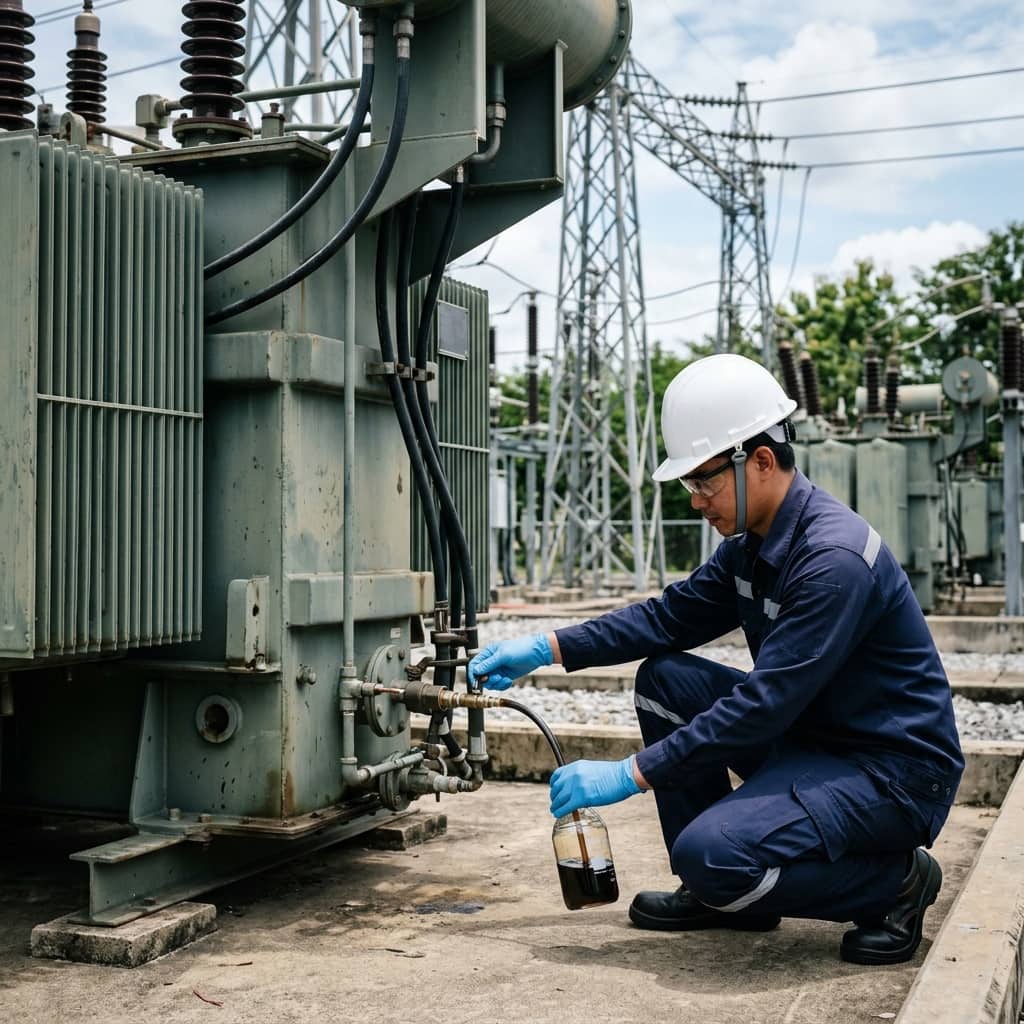
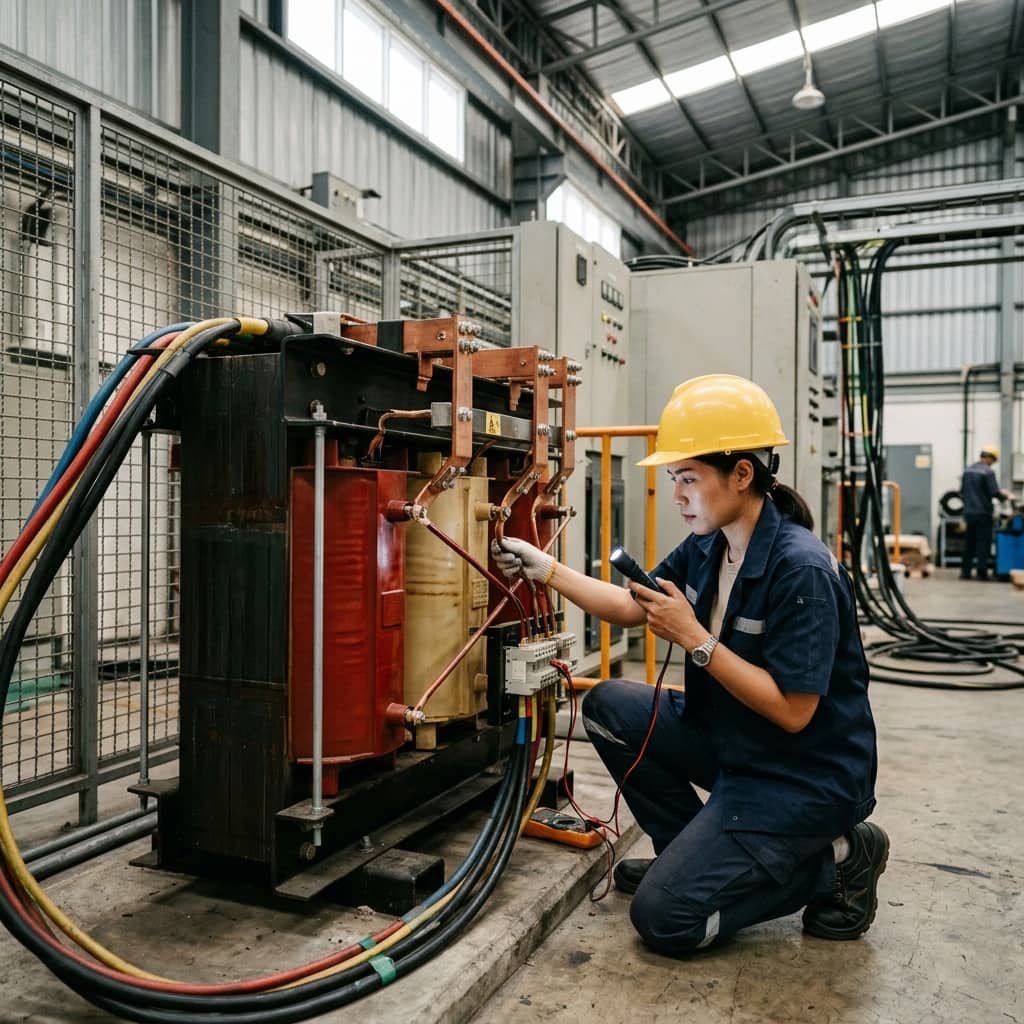
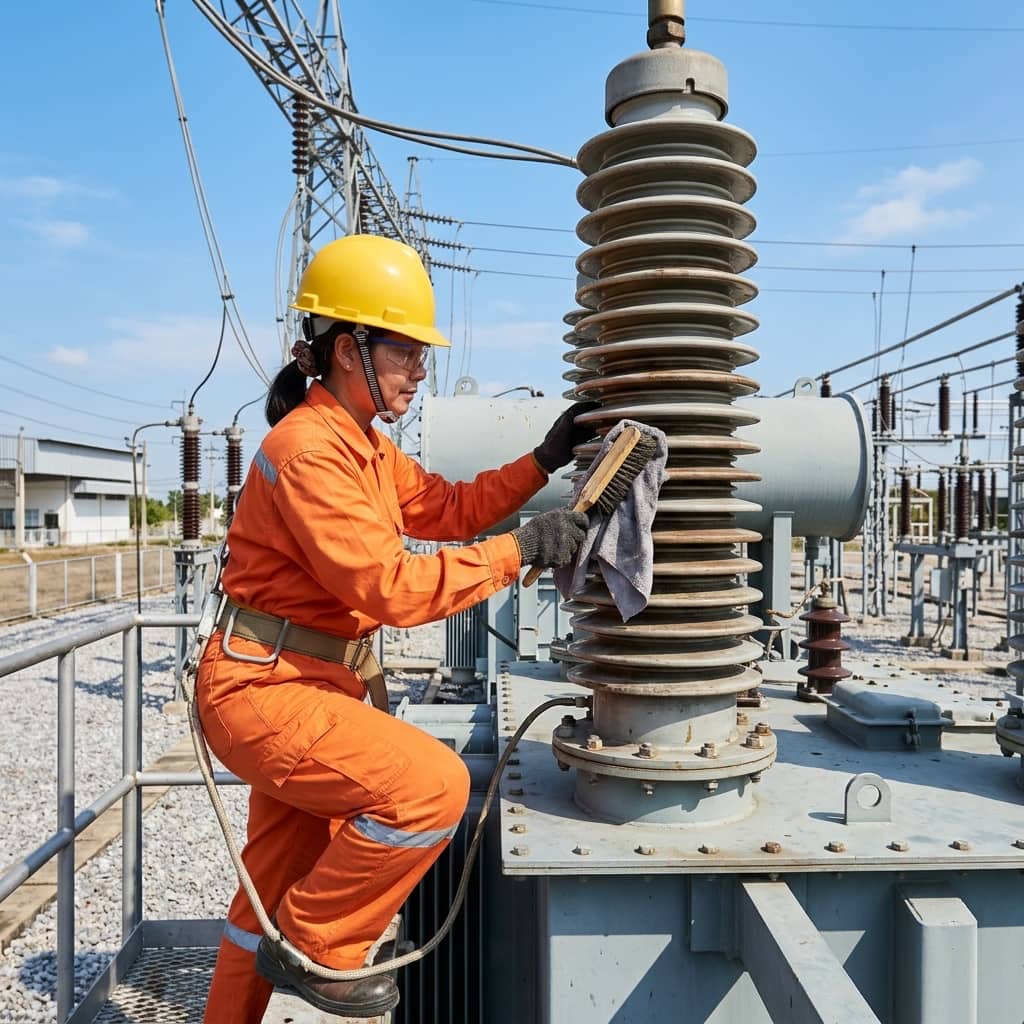
Testing is performed de-energized with the line conductor disconnected from the bushing terminal. The HV test set (typically at 10 kV) energizes the top terminal while the signal is measured through the test tap in UST (Ungrounded Specimen Test) mode, isolating the C1 insulation from other leakage paths. Beforehand, the porcelain surface must be cleaned and dried — surface contamination and moisture create external leakage that inflates readings even when internal insulation is sound. The test tap cover must be securely refitted after every test: a tap left open or loose will arc and destroy the bushing on its own.
The dominant confounding factors are temperature and ambient humidity. OIP Tan Delta varies significantly with temperature, so year-over-year comparison requires recording the test temperature and correcting to a 20°C base using the manufacturer's tables. Avoid testing on days of very high relative humidity or dew. Interference fields from adjacent energized busbars in the substation also cause unstable readings; modern test sets provide line-frequency interference suppression modes that should be engaged when neighboring equipment remains energized.
4. Trend Interpretation and the Replacement Decision
The cardinal interpretation rule: trend matters more than absolute value. A bushing whose Tan Delta holds steady year after year, even if slightly higher than its peers, is generally safer than one whose value climbs continuously. Comparison should run on three axes simultaneously — against factory values, against the unit's own previous results, and against sister bushings of the same type on the other phases of the same transformer, which share the identical environment. A value that stands out from the group is stronger evidence than any single number.
When results clearly indicate degradation — especially a stepwise C1 increase — do not wait for the next test cycle: escalate surveillance frequency or remove the bushing from service according to severity, because a bushing with puncturing layers can cascade to failure quickly. For critical substations, online bushing monitoring that continuously measures test tap leakage current and compares three-phase balance eliminates the blind spot between test intervals. Good practice also includes stocking spare bushings for the ratings in service — HV bushings often carry long manufacturing lead times, and waiting for a spare means the entire transformer sits idle.
Need engineering consultation regarding Transformer?
The WIN TECH SERVICE engineering team is ready to provide site surveys, electrical system inspections, and prepare accurate legal certification reports.