Vacuum Circuit Breaker (VCB) Contact & Interrupter Testing
📌 Executive Summary
Evaluating vacuum bottle integrity, contact erosion, opening/closing synchronization times, and insulation resistance.
1. How VCBs Work and Why Periodic Testing Matters
A Vacuum Circuit Breaker (VCB) interrupts the arc inside a sealed vacuum interrupter, where pressure is so low that ions and electrons produced by the arc recombine almost instantly at current zero. This allows a VCB to clear short-circuit currents very quickly with virtually no maintenance of the arc-quenching medium, unlike oil or gas breakers, making it the standard choice for 12–36 kV medium-voltage systems in industrial plants and large buildings.
Although the vacuum bottle itself is a rugged sealed component, overall VCB performance still depends on the operating mechanism, springs, contacts, and control circuits — all of which degrade with operation count and age. Periodic testing exists to confirm the breaker will actually clear a fault within the time the protection scheme assumes; a breaker that opens just a few cycles late can dramatically enlarge short-circuit damage.
2. Applicable Standards and Test Criteria
VCB design and type testing follow IEC 62271-100 for high-voltage AC circuit breakers. For field maintenance testing, manufacturer instructions are typically combined with widely used industry acceptance and maintenance testing practice, such as ANSI/NETA MTS, which systematically lists test items and comparison criteria for each class of switchgear and breaker.
Key recorded values include contact resistance in micro-ohms, closing and opening times, synchronism of the three poles, insulation resistance phase-to-phase and phase-to-earth, and the vacuum integrity test performed by applying high voltage across the open contacts. All results should be compared against the original fingerprint test data and the manufacturer's limits.
- IEC 62271-100 — high-voltage AC circuit breaker standard
- ANSI/NETA MTS — field maintenance testing practice
- Contact resistance (µΩ), timing tests, insulation resistance, vacuum integrity
- Always benchmark against original fingerprint values
3. Step-by-Step Field Testing Procedure
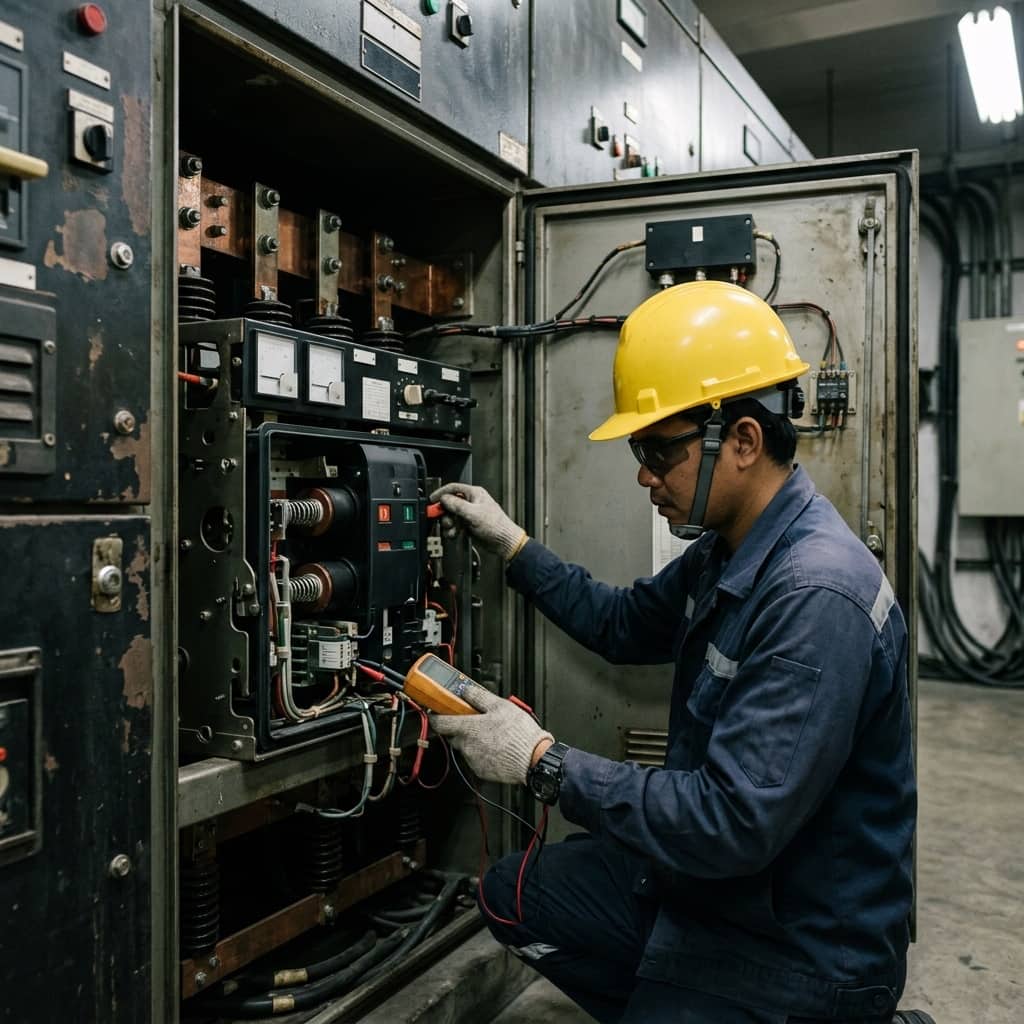
After racking out the breaker and fully discharging the spring mechanism, begin with a visual inspection for dust, arc traces, and mechanism lubrication. Measure contact resistance with a DC micro-ohmmeter injecting at least 100 A; abnormally high or unbalanced readings between phases indicate contact wear or loose joints. Follow with a timing test to record closing time, opening time, and pole spread, which must stay within manufacturer limits.
Vacuum interrupter integrity is verified by applying the manufacturer-specified high voltage across the open contacts — a bottle that has lost vacuum breaks down immediately. Also check contact erosion (wipe) against the manufacturer's marks or dimensions, verify trip and close coil operation at minimum control voltage, and finish with a live trip test initiated from the actual protection relay to prove the complete trip circuit.
4. Common Degradation Modes and How to Prevent Them
The most common problem in aging VCBs is a sluggish mechanism caused by hardened grease, gradually lengthening opening time with no external symptoms. Breakers that rarely operate, such as incoming feeders, are especially at risk. Other frequent issues are contact erosion from accumulated fault interruptions and trip coils failing open or loose from heat and vibration — discovered only when a trip command produces no action, the most dangerous scenario of all.
Prevention combines time-based and operation-count-based test intervals: exercise rarely operated breakers at least once a year, re-grease mechanisms at manufacturer-recommended intervals, log fault interruption counts to estimate contact wear, and prove the trip circuit from the actual relay at every available outage so the entire protection chain is known to be ready.
- Hardened grease is the leading cause of slow tripping
- Exercise rarely operated breakers at least annually
- Log cumulative fault interruption counts
- Prove the trip circuit from the real relay at every outage
Need engineering consultation regarding High Voltage?
The WIN TECH SERVICE engineering team is ready to provide site surveys, electrical system inspections, and prepare accurate legal certification reports.