Importance of Transformer Turns Ratio (TTR) Verification
📌 Executive Summary
How TTR measurement validates winding voltage ratios, vector groups, and identifies inter-turn insulation faults.
1. Why the Turns Ratio Matters
The turns ratio is the heart of voltage transformation: primary-to-secondary voltage is directly proportional to the number of turns on each winding. The TTR (Transformer Turns Ratio) test verifies that the actual windings inside the tank match the design and remain intact. Measured values are compared against ratios calculated from the nameplate voltages at each tap position.
A ratio deviation reflects serious defects such as inter-turn short circuits, which can arise when the conductor's turn insulation degrades or is destroyed by heat. When turns short together, the effective number of working turns drops and the ratio drifts from design. This defect is invisible to ordinary insulation resistance tests because the short is within a single winding — making TTR the most sensitive screen for it, and a mandatory test before energizing any new or freshly repaired transformer.
2. Standard Criteria and Vector Groups
IEC 60076-1 sets the voltage ratio tolerance at plus or minus 0.5 percent of the declared value at the principal tap, and the same criterion is applied to field results. Measurement must cover every phase and every tap position. For three-phase units the vector group (e.g., Dyn11, YNd1) must be accounted for, since delta or wye connections affect the measured phase ratios; modern test sets accept the vector group setting and compute the comparison automatically.
TTR testing also confirms the vector group and polarity, which is critical before paralleling two transformers: mismatched vector groups produce enormous circulating currents the instant they are paralleled. When a typical industrial plant replaces a transformer with a new unit, vector group verification before cabling is a step that must never be skipped — even if the nameplates agree — because manufacturing or internal connection errors do genuinely occur.
- IEC 60076-1 criterion: ratio deviation within ±0.5% at the principal tap
- Measure all phases at all tap positions
- Always verify the vector group before paralleling transformers
- Ratio drift signals inter-turn shorts invisible to ordinary insulation tests
3. Field Test Procedure
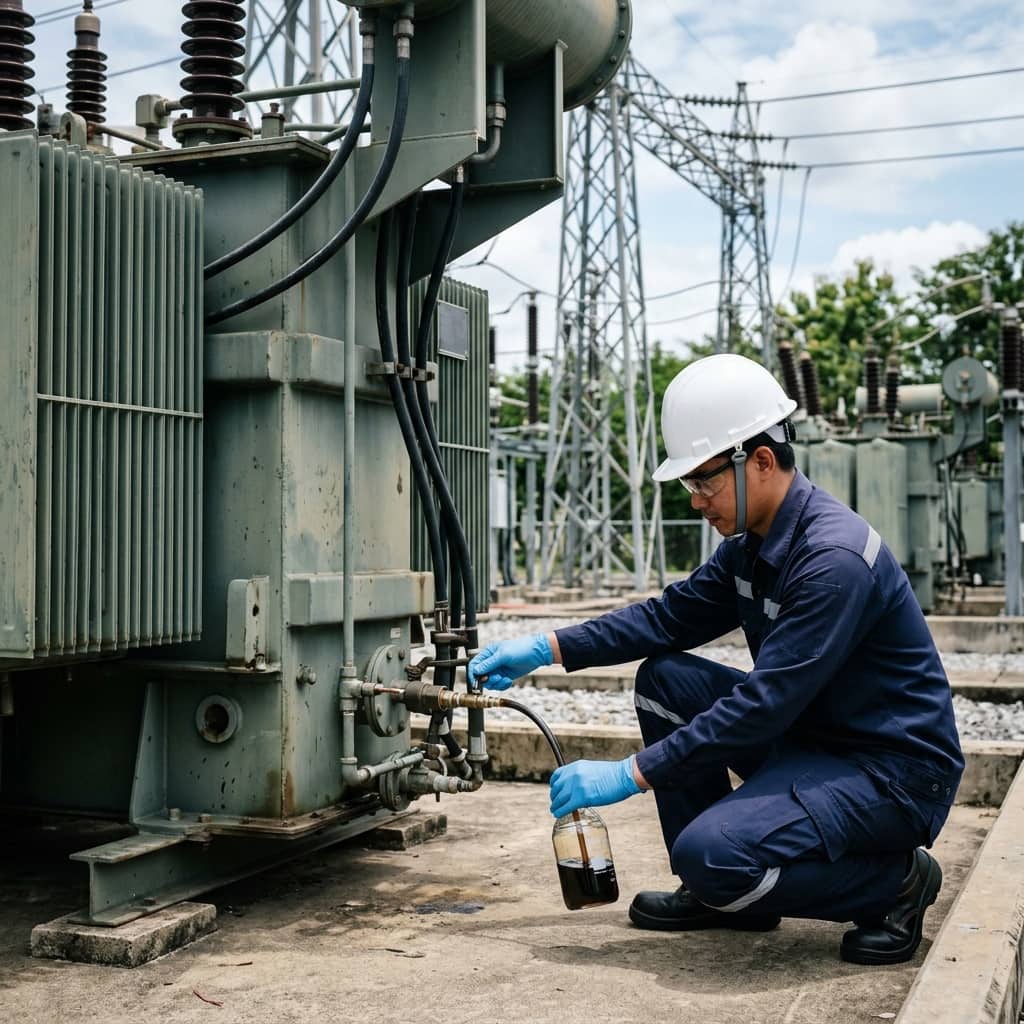
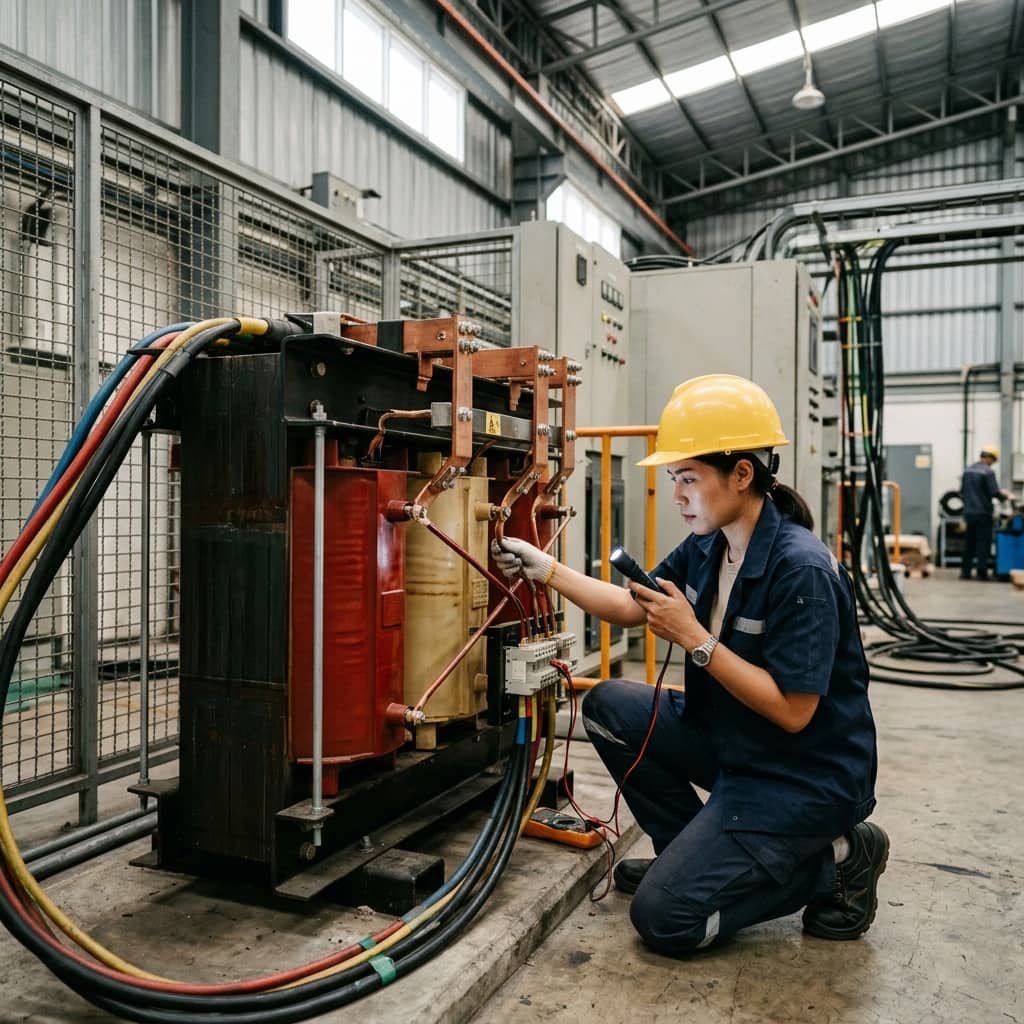
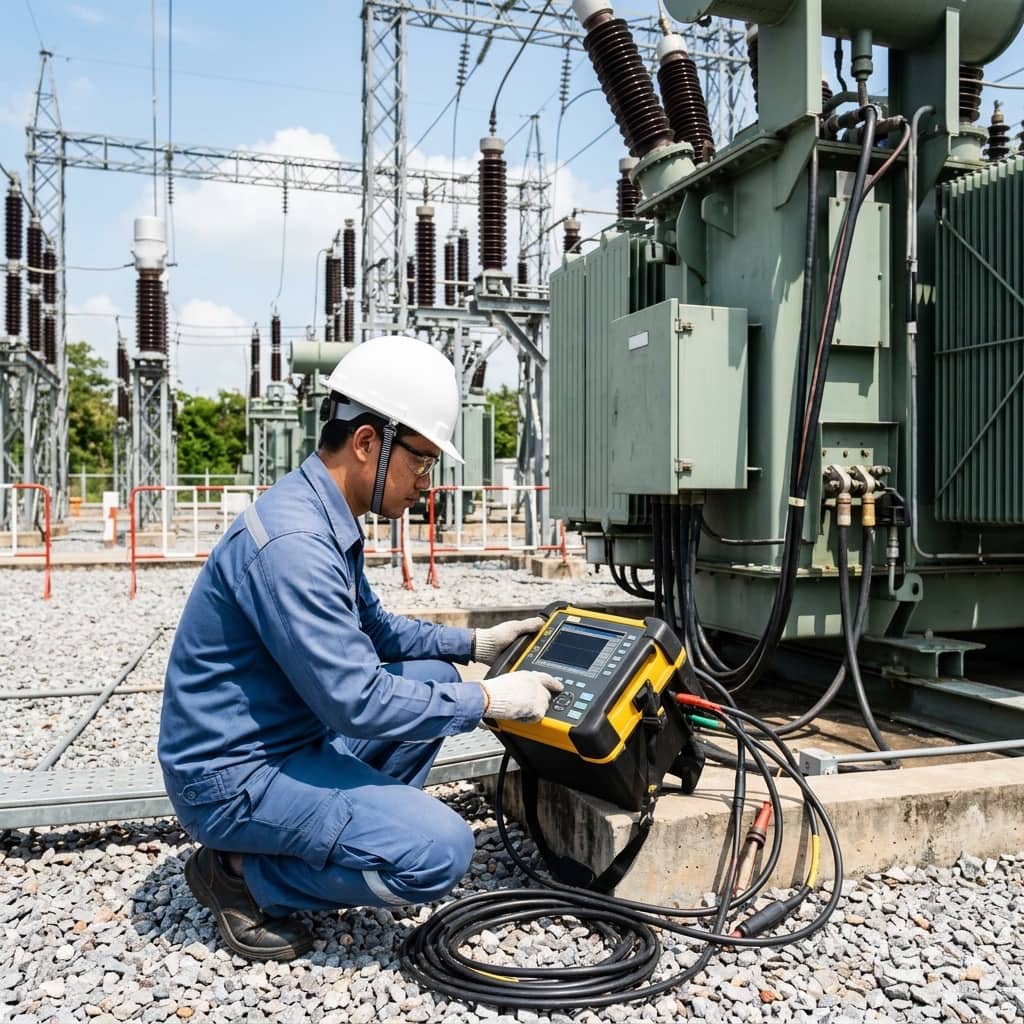
A TTR set works by applying a low AC voltage (typically no more than a few tens of volts) to the HV side and measuring the induced voltage and phase angle on the LV side. Energizing the HV side keeps the exciting current low, which is both safer and more accurate. Before measuring, disconnect all external connections on both sides — including neutrals and any connected surge arresters — since even a small residual load skews the result.
The recommended sequence is to step from the highest tap down to the lowest, covering all phases at each position, recording the ratio, percent deviation, exciting current, and phase angle. Abnormally high exciting current on one phase is valuable supplementary evidence, flagging core problems or shorted turns before the ratio itself deviates clearly. Afterward, file results against previous tests and the factory report to track the long-term trend, as with any diagnostic test.
4. Common Anomalies and Follow-Up Diagnosis
Common anomaly patterns include out-of-tolerance ratios on all taps of one phase, typically indicating shorted turns in that winding; deviations only at certain taps, implicating the tapping winding or tap changer contacts; and unmeasurable ratios or extreme exciting current, suggesting an open circuit or severe short. In every case, retest and verify lead connections before drawing conclusions.
Once an anomaly is confirmed, follow up with complementary tests: winding resistance to separate joint problems from turn insulation problems, DGA to look for thermal or arcing signatures in the oil, and SFRA (Sweep Frequency Response Analysis) to detect mechanical winding deformation. Combining these results supports the right decision on severity — from contact issues correctable externally, up to internal shorted turns that require shipping the transformer to a workshop for rewinding.
Need engineering consultation regarding Transformer?
The WIN TECH SERVICE engineering team is ready to provide site surveys, electrical system inspections, and prepare accurate legal certification reports.