Silica Gel Breather Maintenance & Moisture Control
📌 Executive Summary
Replacing and regenerating silica gel desiccant to prevent ambient moisture absorption into transformer oil tanks.
1. The Breather's Role in the Transformer Breathing System
A conservator-type oil transformer "breathes" continuously. As load rises, the oil heats and expands, pushing air out of the conservator; as load falls or night air cools the unit, the oil contracts and draws outside air back in. The silica gel breather is the moisture filter on this incoming air. Without it — or with exhausted desiccant — ambient moisture enters the oil system directly, a little every day, accumulating over years until the insulation values are ruined.
Moisture is the worst enemy of the transformer insulation system: beyond depressing the oil's breakdown voltage, it accelerates paper insulation aging multiplicatively. As an engineering rule of thumb, the paper aging rate roughly doubles when the moisture content in the paper doubles. A small, inexpensive device like the silica gel breather thus has an outsized impact on transformer life, and it is the first checkpoint a maintenance engineer should glance at every time they walk past the unit.
2. Reading the Color and Replacement Criteria
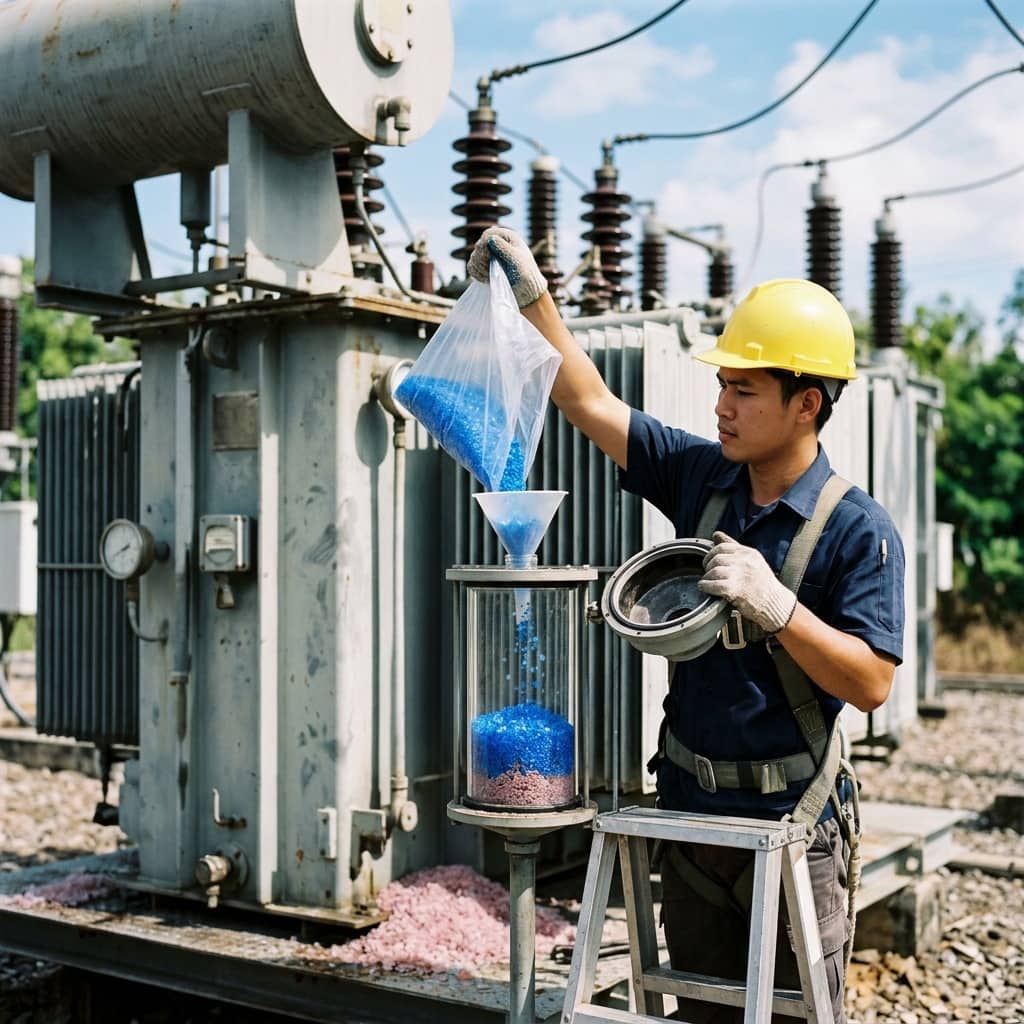
Transformer-grade silica gel carries a color indicator that changes with absorbed moisture. The prevalent type today is orange gel that turns dark green or colorless when saturated (the older blue-to-pink type has been phased out in many countries because its cobalt chloride indicator is hazardous). Common practice is to replace or regenerate once about two-thirds of the column has changed color, observing from the bottom up since incoming air enters from below.
Inspection should be at least monthly, and more frequent during the rainy season when relative humidity is high. If a unit exhausts its silica gel unusually fast — needing replacement every few weeks under normal load — that signals air leaking into the system elsewhere, such as degraded conservator gaskets or abnormally heavy breathing from a strongly cycling load; find the cause rather than simply replacing the gel more often. Saturated gel can be oven-regenerated at the manufacturer's specified temperature until the color returns, but the charge should be fully renewed once granules begin crumbling or no longer regain full color.
- Replace/regenerate once about two-thirds of the column changes color
- Check the color at least monthly, more often in the rainy season
- Abnormally fast color change signals air leaking in elsewhere
- Renew the whole charge when granules crumble or color no longer recovers
3. The Oil Seal Cup and Correct Replacement Procedure
At the base of the breather sits an oil seal cup acting as a natural one-way air valve: air passes only when the pressure differential is enough to push through the oil layer, which blocks dust and limits constant exposure to humid air. The oil level must sit at the marked line — if the cup runs dry, air flows freely at all times and the silica gel saturates rapidly; if overfilled, the breather cannot breathe and oil may be pushed up to wet the desiccant.
Correct replacement starts with fresh or regenerated desiccant kept in a sealed container. Remove the breather carefully, empty the spent charge, clean and thoroughly dry the housing and internal screen, then refill promptly to the specified level so the new charge does not pre-absorb ambient moisture. Check the breather's gasket and O-ring, reassemble tightly, refill the oil cup to the mark, and record the replacement date on a tag or in the maintenance system to track the charge's life for the next cycle.
4. Common Mistakes and Newer Alternatives
Common field mistakes include letting the entire silica gel column sit saturated unnoticed for long periods, forgetting to refill the oil cup after cleaning, leaving the shipping plug or moisture-seal wrap installed on a new breather — which blocks breathing and causes abnormal tank pressure — and using non-transformer-grade desiccant that crumbles into dust and clogs the air path. All are preventable by putting breather inspection explicitly on the monthly checklist.
For critical or hard-to-reach transformers, self-dehydrating (maintenance-free) breathers are now available: a heating element automatically drives moisture out of the desiccant on a timed cycle or based on measured humidity, eliminating routine replacement and the risk of forgotten checks. These devices, however, require auxiliary power and add electronic failure modes. Selection should weigh the transformer's criticality, how often crews can realistically visit the site, and whether a monitoring system exists to raise an alert when the breather itself malfunctions.
Need engineering consultation regarding Transformer?
The WIN TECH SERVICE engineering team is ready to provide site surveys, electrical system inspections, and prepare accurate legal certification reports.