On-Load Tap Changer (OLTC) Maintenance Best Practices
📌 Executive Summary
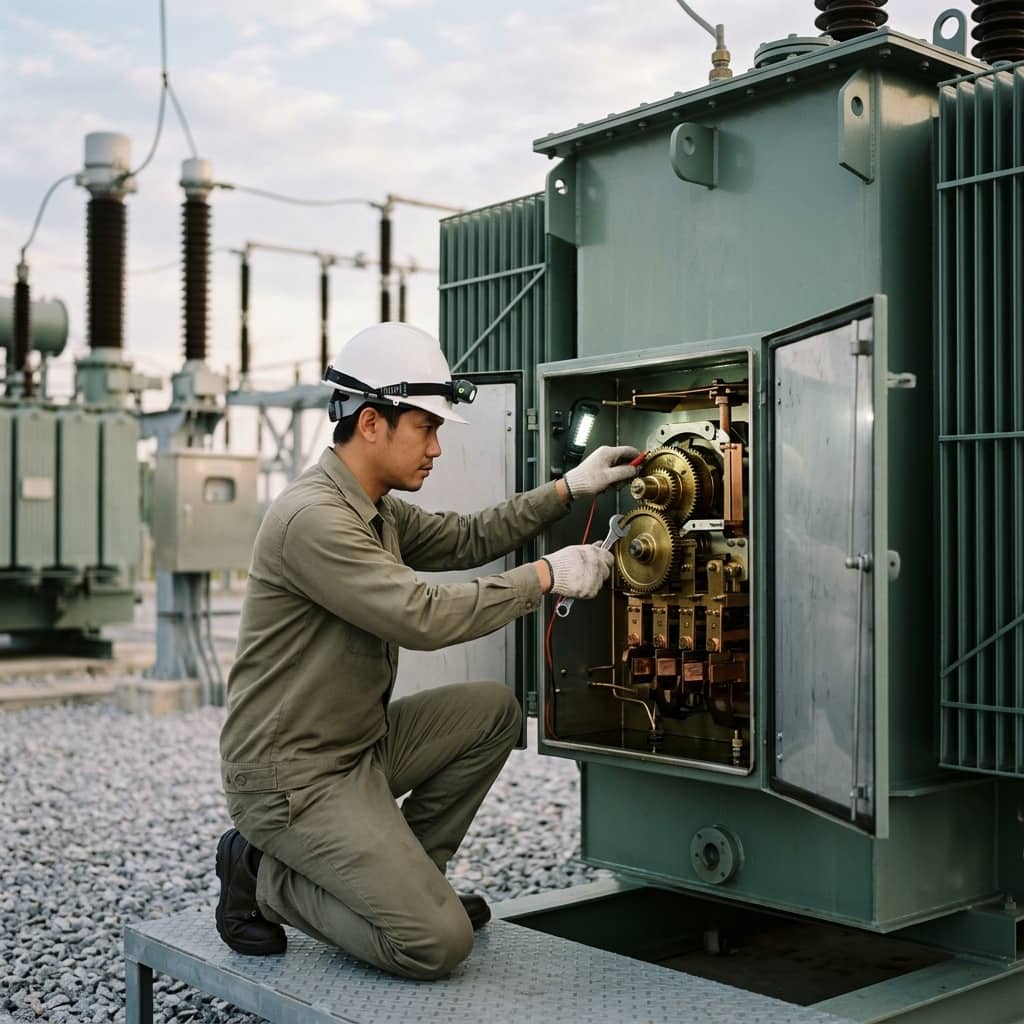
Inspection of contacts, diverter switches, and motor drive mechanisms to ensure smooth voltage regulation without arcing damage.
1. The OLTC: The Transformer's Hardest-Working Moving Part
The On-Load Tap Changer (OLTC) adjusts the winding turns ratio to hold downstream voltage steady without an outage. It comprises a tap selector, which pre-selects the next winding position without breaking current, and a diverter switch, which transfers load current from the old tap to the new one through transition resistors within a fraction of a second. Contact arcing during this transfer is normal by design — but it is also the source of cumulative wear.
Failure surveys across the global power industry consistently rank the OLTC among the top causes of failure for transformers equipped with one. The reason is simple: it is a mechanical mechanism operating thousands to tens of thousands of times per year, immersed in oil contaminated by carbon from its own arcing. Maintenance at the manufacturer's specified intervals is therefore not optional — it is a precondition for the reliability of the plant's entire electrical system.
2. Operation-Count-Based Intervals and Applicable Standards
Unlike equipment maintained on calendar time alone, OLTC intervals are defined by operation count together with time, whichever comes first. Figures vary by manufacturer and contact technology: copper contacts switching in oil typically call for a major inspection every hundred thousand-plus operations or every 6-7 years, while vacuum interrupter OLTCs extend intervals considerably because arcing is confined inside vacuum bottles and never contaminates the oil. The operation counter on the motor drive cabinet is therefore a maintenance datum to record at every inspection.
The governing standards are IEC 60214-1, covering performance requirements and testing of the device, and IEC 60214-2, giving application guidance. One point both the standards and manufacturer manuals stress: the diverter switch compartment oil is deliberately a separate system from the main tank, because it carbonizes quickly. Its oil is judged against separate criteria — and DGA results from the OLTC compartment must never be interpreted with main-tank limits, since gases from normal OLTC arcing would falsely suggest a severe transformer fault.
- IEC 60214-1/-2: OLTC performance standard and application guide
- Intervals set by operation count together with elapsed time, whichever first
- Record the operation counter at every inspection
- Diverter compartment oil has separate criteria — never mix its DGA interpretation with the main tank
3. Core Maintenance Tasks at Overhaul
An OLTC overhaul begins with an outage, isolation, and withdrawal of the diverter switch insert from its oil compartment (on designs removable from the top). Main and arcing contact thicknesses are then measured against the manufacturer's wear limits and parts at the limit are replaced. Transition resistors are verified by resistance measurement, the spring energy accumulator — which makes each switching operation fast and consistent regardless of motor speed — is inspected, and the compartment is cleaned and refilled with new oil.
On the motor drive unit, check the motor, gearing, lubrication points, end-position limit switches, and agreement between the tap position indicator and the actual mechanism position. Any out-of-step condition between indicator and mechanism is a serious defect that must be fully eliminated. After reassembly, run the changer through its full range several times, measure winding resistance at every tap, and where instrumentation allows, perform Dynamic Resistance Measurement (DRM) to capture the diverter's current-transfer waveform — a window into contact health and mechanism timing without reopening the compartment.
4. In-Service Warning Signs and Monitoring
Between overhauls, warning signs of a deteriorating OLTC include a changed or prolonged switching sound, frequent motor drive overload trips, an abnormally fast-rising operation count (often caused by an automatic voltage regulator with too narrow a bandwidth commanding needless tap changes), and an OLTC compartment running hotter than the main tank — unnatural, since the compartment has no primary heat source of its own. Such an inverted temperature profile should immediately raise suspicion of high-resistance contacts.
Modern monitoring practice installs sensors for the OLTC-to-main-tank temperature differential and analyzes the motor current signature on every operation: a stretched or abnormally peaked motor current waveform reveals a binding mechanism or fatigued springs before actual failure. AVR settings deserve review as well — tune bandwidth and time delay to balance voltage quality against operation count, because every switching operation is cumulative wear. Eliminating unnecessary operations is preventive maintenance at zero cost.
Need engineering consultation regarding Transformer?
The WIN TECH SERVICE engineering team is ready to provide site surveys, electrical system inspections, and prepare accurate legal certification reports.