Interpreting DGA Gas Ratios Using Duval Triangle & Rogers Ratio Methods
📌 Executive Summary
Determining exact fault types: thermal fault (T1/T2/T3), partial discharge (PD), or high energy arcing (D1/D2) from oil DGA lab results.
1. Dissolved Gases: The Transformer's Blood Test
When a fault develops inside an oil-filled transformer — overheating, partial discharge, or arcing — the energy breaks down oil and paper insulation molecules into gases that dissolve in the oil: hydrogen (H2), methane (CH4), ethane (C2H6), ethylene (C2H4), acetylene (C2H2), plus carbon monoxide (CO) and carbon dioxide (CO2) from cellulose degradation. The types and proportions of gas generated correlate directly with the energy level of the fault.
Dissolved Gas Analysis (DGA) is therefore the transformer's blood test, revealing internal health without opening the tank. Acetylene, for example, requires arc-level temperatures to form, so any significant acetylene is always a danger signal; dominant ethylene indicates a high-temperature hot spot; and dominant hydrogen with little hydrocarbon gas points to partial discharge. The principal interpretation standards are IEEE C57.104 and IEC 60599.
2. Interpretation with the Duval Triangle
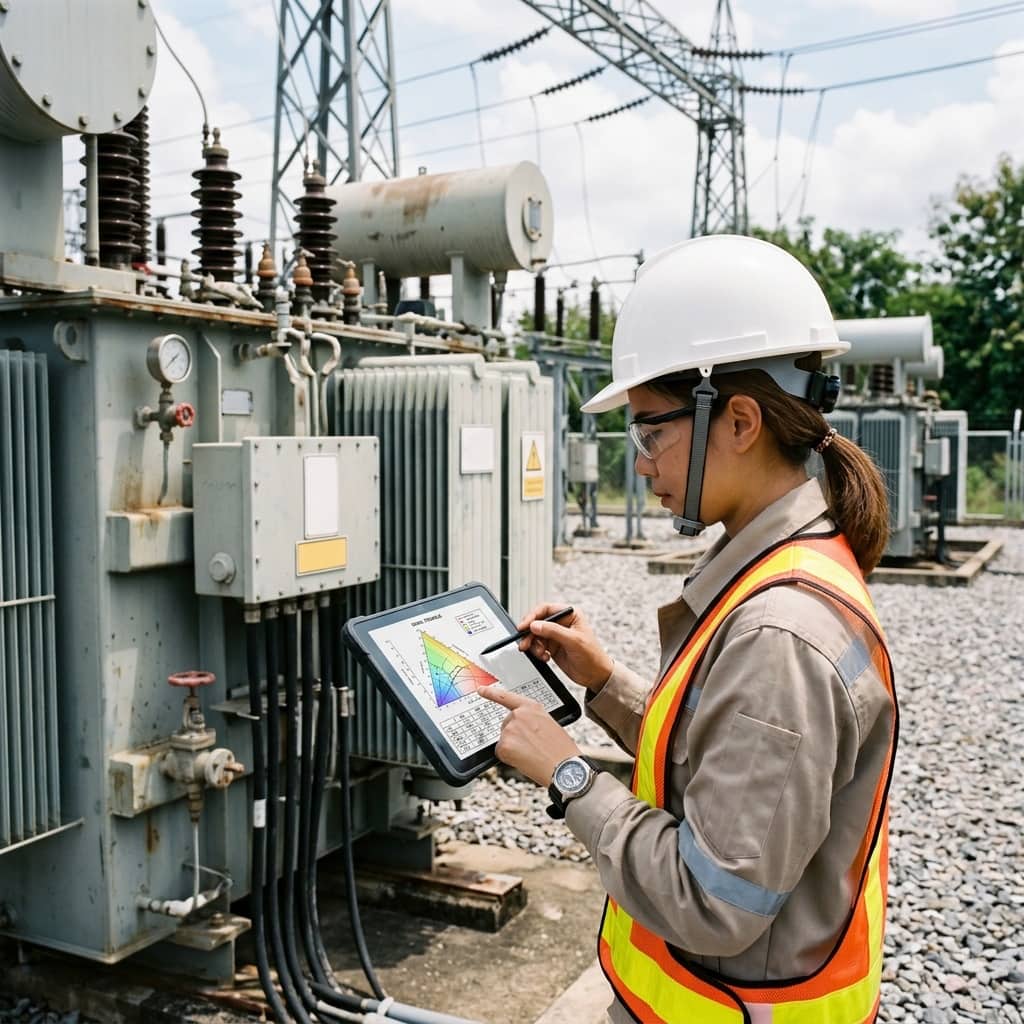
Duval Triangle 1 uses three gases — methane, ethylene, and acetylene — expressing each as a percentage of their combined total and plotting the point on a triangular chart divided into diagnostic zones: PD (partial discharge), D1 (low-energy discharge), D2 (high-energy discharge/arcing), T1 (thermal fault below 300°C), T2 (300-700°C), T3 (above 700°C), and DT (mixed discharge/thermal). Its strength is that it always yields a diagnosis, since every point falls in some zone.
The critical caveat: the Duval Triangle is meant to be applied only after a genuine fault condition is confirmed — gas concentrations above threshold or an abnormal gassing rate. Plotting healthy oil with trace gas levels produces a meaningless diagnosis. The Rogers Ratio method uses gas-pair ratios such as C2H2/C2H4, CH4/H2, and C2H4/C2H6 against a code table to identify the fault type, and serves well as cross-confirmation. Good practice is always to interpret with multiple methods, never a single one.
- PD zone: partial discharge — often linked to moisture or voids in insulation
- D1/D2 zones: low/high-energy discharge — acetylene-dominant, high danger
- T1/T2/T3 zones: thermal faults by temperature range — loose joints, core circulating currents
- Apply Duval only after a fault condition is confirmed
- Cross-check with Rogers Ratio and IEEE C57.104 / IEC 60599 limits
3. Sampling Practice and Test Frequency
DGA interpretation is only as good as the sample. Oil must be drawn from the sampling valve using a gas-tight glass syringe or dedicated bottle, after flushing stagnant oil from the valve, and without exposing the sample to air or bubbles — dissolved gases escape quickly and depress the measured values. Record oil temperature and load at the time of sampling, and ship to the laboratory promptly, protected from sunlight and heat.
Typical frequency is annual for ordinary distribution transformers, increasing for large power transformers or production-critical units. Whenever results show abnormal gas, escalate to short-interval monitoring — every one to three months — to establish the rate of gas generation, which matters more than any single absolute value. A transformer whose gas levels have been stable for years may be living with an old, dormant defect, but rapidly increasing gas is the signal to plan an outage for internal inspection.
4. From Analysis to Maintenance Decisions
Each diagnosis leads to a different follow-up. T2/T3 thermal faults usually stem from loose internal connections, degraded tap-changer contacts, or core circulating currents — confirmed with winding resistance and tap-changer tests. A partial discharge indication calls for PD measurement and an oil moisture check. A D2 result with rapidly rising acetylene is urgent and may justify removing the transformer from service to prevent catastrophic failure.
Common mistakes include panicking over a single reading without trend context and, conversely, ignoring slowly but steadily rising gases. Note also that oil filtration removes dissolved gases, resetting the baseline — this must be recorded, or subsequent comparisons will mislead. Best practice is a lifetime DGA database for every transformer, interpreted by an experienced engineer together with load, temperature, and system event history.
Need engineering consultation regarding Preventive Maintenance?
The WIN TECH SERVICE engineering team is ready to provide site surveys, electrical system inspections, and prepare accurate legal certification reports.