Comprehensive Insulation Resistance Testing (Megger) Guide
📌 Executive Summary
Using Polarization Index (PI) and Dielectric Absorption Ratio (DAR) to accurately assess motor and cable insulation moisture.
1. Principles of Insulation Resistance Testing
Good insulation must prevent current from leaking from a conductor to ground or between phases, but all insulation degrades over time from heat, moisture, contamination, chemicals, and electrical stress. An insulation resistance tester (commonly called a Megger) applies a high DC voltage — typically 500V, 1000V, or 5000V — across the insulation and measures the resulting leakage current, expressing the result as resistance in megohms or gigohms.
A single spot reading is only a rough indicator because it depends heavily on temperature and humidity at the time of the test. Far more valuable is how the resistance behaves over time: dry, healthy insulation shows a steadily rising value under sustained voltage as the polarization current decays, while wet or contaminated insulation stays flat. This behavior is the basis of the DAR and PI indices, which assess insulation health far more reliably than any single number.
2. Interpreting PI and DAR per IEEE 43
The Dielectric Absorption Ratio (DAR) is the ratio of the 1-minute reading to the 30-second reading, while the Polarization Index (PI) is the 10-minute reading divided by the 1-minute reading. IEEE 43, the standard for rotating machine windings, provides the widely used guideline that a PI of 2.0 or higher indicates good insulation, 1.0-2.0 warrants monitoring or further investigation, and below 1.0 points to a clear insulation problem.
One caution: some modern insulation systems with very high resistance (above roughly 5000 megohms at one minute) naturally produce low PI values, and IEEE 43 allows PI to be disregarded in that case. Insulation resistance is also strongly temperature dependent — roughly halving for every 10 degrees Celsius rise — so year-on-year comparisons must always be corrected to a common base temperature such as 40 degrees Celsius.
- DAR = R(1 min) / R(30 s) — a quick field screening test
- PI = R(10 min) / R(1 min) — PI >= 2.0 is considered good per IEEE 43 guidance
- PI < 1.0 indicates wet or severely degraded insulation
- Resistance roughly halves per 10°C rise; correct to a base temperature before comparing
- Very high first-minute readings may make PI evaluation unnecessary
3. Safe Field Test Procedure
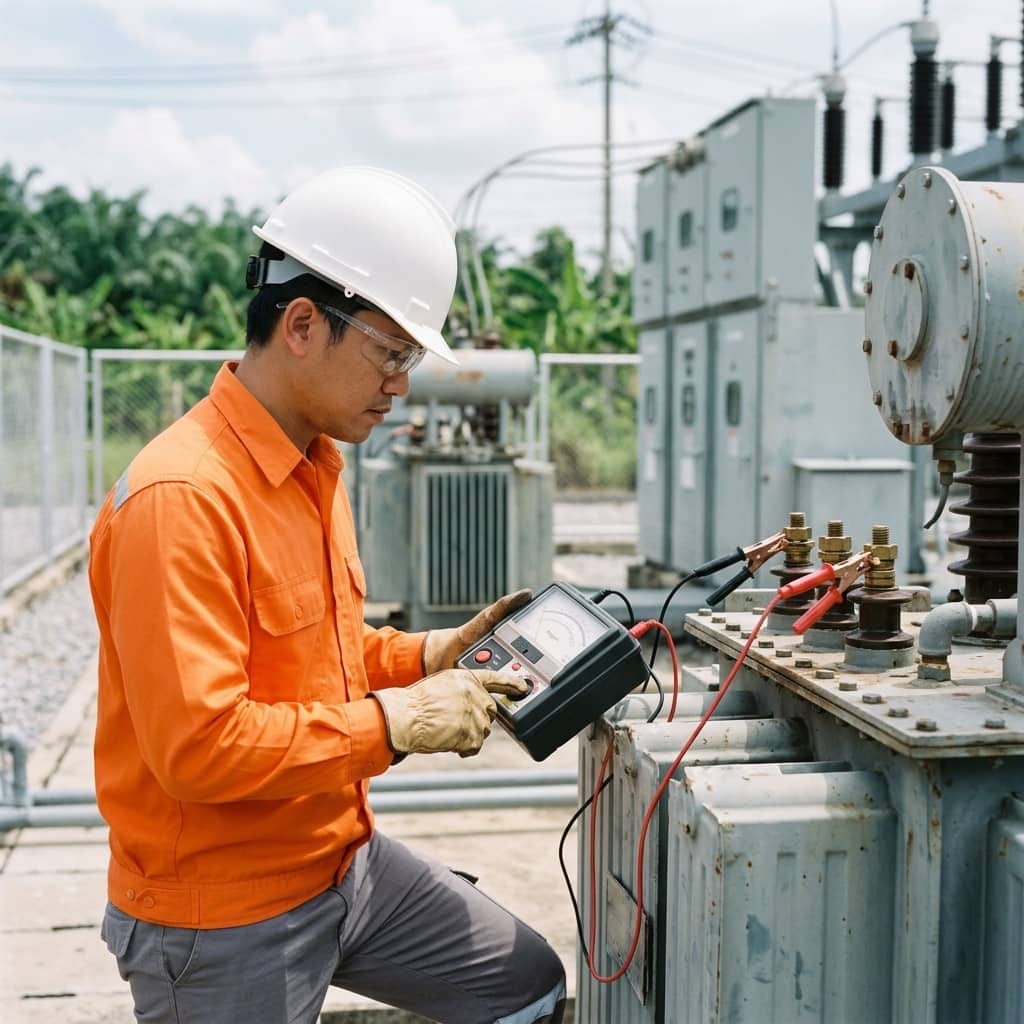
Before testing, the equipment must be completely isolated, verified de-energized with a trusted tester, and any voltage-sensitive electronics — VFDs, capacitor units, sensors — disconnected from the circuit under test. Test voltage must match the equipment rating: 400V low-voltage systems are typically tested at 500-1000V DC, while motors and high-voltage cables use 2500-5000V DC per IEEE 43 guidance and manufacturer recommendations.
Record readings at 30 seconds, 1 minute, and 10 minutes together with temperature and relative humidity. The step newcomers most often skip is discharging after the test: insulation stressed with DC stores charge like a large capacitor, and it must be grounded for at least as long as the voltage was applied (some guides recommend four times as long) before anyone touches the conductor, or a residual-charge shock can result.
4. Why Insulation Values Drop and How to Recover Them
The number-one cause of low insulation readings in the field is moisture, especially in motors idle for long periods or installed in damp areas. Conductive dust, oily grime on winding surfaces, and heat-aged varnish follow close behind. Moisture-related cases can usually be recovered by drying out the winding with heated air or low-current circulation, then re-testing until PI returns to acceptable limits.
If values remain low after cleaning and drying, the insulation has degraded structurally — cracked varnish or deteriorated slot insulation — and a rewind or replacement must be considered. The best defense is annual testing with trend records: insulation almost never fails suddenly without warning, and a value that keeps dropping by more than half its previous reading year after year is the signal to plan a repair before it fails mid-production.
Need engineering consultation regarding Preventive Maintenance?
The WIN TECH SERVICE engineering team is ready to provide site surveys, electrical system inspections, and prepare accurate legal certification reports.