Why Annual Thermo-Scan Inspection Saved Factory Downtime
📌 Executive Summary
Detecting loose connections and overloaded circuit breakers before thermal breakdown occurs.
1. Why Hot Spots Are the Most Important Early Warning Sign
Almost every abnormal temperature rise in an electrical system traces back to increased resistance at a specific point — a loosened cable termination, worn breaker contacts, or a circuit carrying more load than it was designed for. By Joule's Law, power loss is proportional to the square of the current times resistance, so even a slightly loose joint under heavy current accumulates heat rapidly. Left unchecked, the insulation degrades, arcing begins, and the fault can escalate into a switchboard fire.
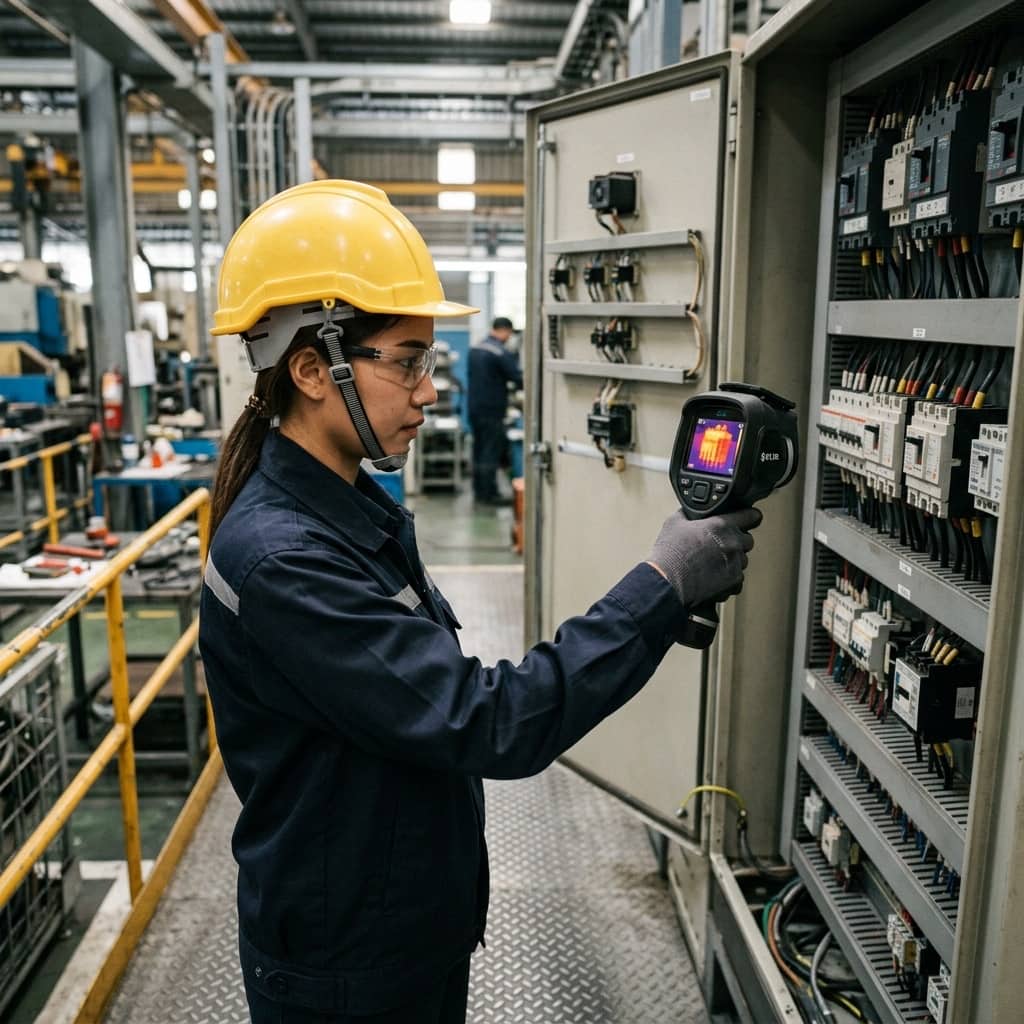
Infrared thermography detects these problems without touching the equipment and without a power outage, which means the survey can be performed while the plant runs under real load. This is essential: hot spots only reveal themselves clearly when the circuit carries roughly 40% or more of its normal current. An annual thermo-scan has therefore become a cornerstone of preventive maintenance, delivering one of the highest returns of any inspection technique relative to the downtime it prevents.
2. Reference Standards and Legal Requirements
NFPA 70B (Standard for Electrical Equipment Maintenance) recommends infrared inspection of electrical equipment at least annually, with shorter intervals for critical equipment or harsh environments. NFPA 70E, the workplace electrical safety standard, additionally requires personnel opening energized panel covers to wear arc-flash PPE appropriate to the assessed incident energy level.
In Thailand, the Ministerial Regulation on Occupational Safety, Health and Environment Concerning Electricity B.E. 2558 (2015) requires employers to arrange an annual inspection and maintenance of the electrical system by a qualified engineer or legally recognized inspector. A systematically prepared thermographic survey report can be used directly as supporting evidence for the annual electrical system certification.
- NFPA 70B: thermographic survey recommended at least once a year under real load
- NFPA 70E: safety and PPE requirements when opening energized enclosures
- Thai Ministerial Regulation B.E. 2558: annual electrical inspection by qualified personnel
- Severity is typically graded by temperature difference (Delta-T) against adjacent phases or ambient
3. Professional Thermo-Scan Procedure
An effective survey starts with a planned inspection route covering transformers, MDB, DB and MCC panels, busbars, main cable terminations, and capacitor banks. The thermographer must record the actual load current of each circuit with a clamp meter alongside every thermal image, because a lightly loaded circuit on inspection day can hide a real defect. Emissivity and reflected temperature must also be set correctly — otherwise readings can be badly wrong, especially on shiny metallic surfaces.
Each finding is graded by Delta-T into severity classes such as monitor, plan repair at next opportunity, and correct immediately, with a visual image paired to each thermal image and the exact location identified. A good report also compares results against previous years to establish trends, which is what separates a normally warm, heavily loaded conductor from a connection that is genuinely deteriorating.
4. Common Findings and Corrective Actions
In industrial plants, the most frequent finding is a termination tightened without proper torque or loosened over time by thermal cycling. Other common defects include breakers with degraded internal contacts, oxidized fuse holders, phase imbalance causing an overheated neutral, and capacitor banks with failing internal cells.
The correct fix is not simply to tighten the joint harder: connections must be re-torqued with a torque wrench to the manufacturer's specified value, contact surfaces inspected for burning or oxide and cleaned or replaced if damaged, and a post-repair scan performed to confirm the hot spot is actually gone. Closing out findings without re-scanning is the usual reason the same defect reappears in the following year's survey.
- Re-torque connections with a torque wrench to manufacturer specification, never by feel
- Inspect contact surfaces; clean or replace if arcing marks or oxide are found
- Correct phase imbalance before the neutral conductor is overloaded
- Re-scan every repaired point to verify the fix
- Keep year-on-year reports for trend analysis
Need engineering consultation regarding Preventive Maintenance?
The WIN TECH SERVICE engineering team is ready to provide site surveys, electrical system inspections, and prepare accurate legal certification reports.