SF6 Gas Recovery, Vacuum Evacuation & Recycling Standards
📌 Executive Summary
Environmental regulations and equipment procedures for handling SF6 greenhouse gas during high voltage equipment servicing.
1. SF6 and the Environment: Why Venting Is Forbidden
SF6 is one of the most potent greenhouse gases in industrial use, with a global warming potential tens of thousands of times that of carbon dioxide by mass and an atmospheric lifetime of thousands of years. Venting even a small cylinder is equivalent to a year's CO2 emissions from many cars. International electrical industry practice therefore treats deliberate venting during service work as absolutely prohibited, regardless of quantity.
Work on SF6 equipment follows a closed-loop lifecycle: gas must be recovered into storage before any compartment is opened, filtered and reclaimed for re-use when quality permits, and sent for proper destruction when degraded beyond recovery. Personnel should be specifically trained in gas handling — beyond the environmental issue, the decomposition products of arced SF6 are toxic and demand appropriate personal protective equipment.
2. Gas Handling Standards and Re-Use Criteria
SF6 handling practice follows IEC 62271-4, which specifies use and handling procedures across the switchgear lifecycle, together with IEC 60480, which sets quality criteria — moisture, air content, and decomposition product limits — for re-use of recovered gas. When analysis passes these limits, gas processed through the recovery unit's filter train can be returned to equipment without purchasing new gas, cutting both cost and greenhouse emissions at once.
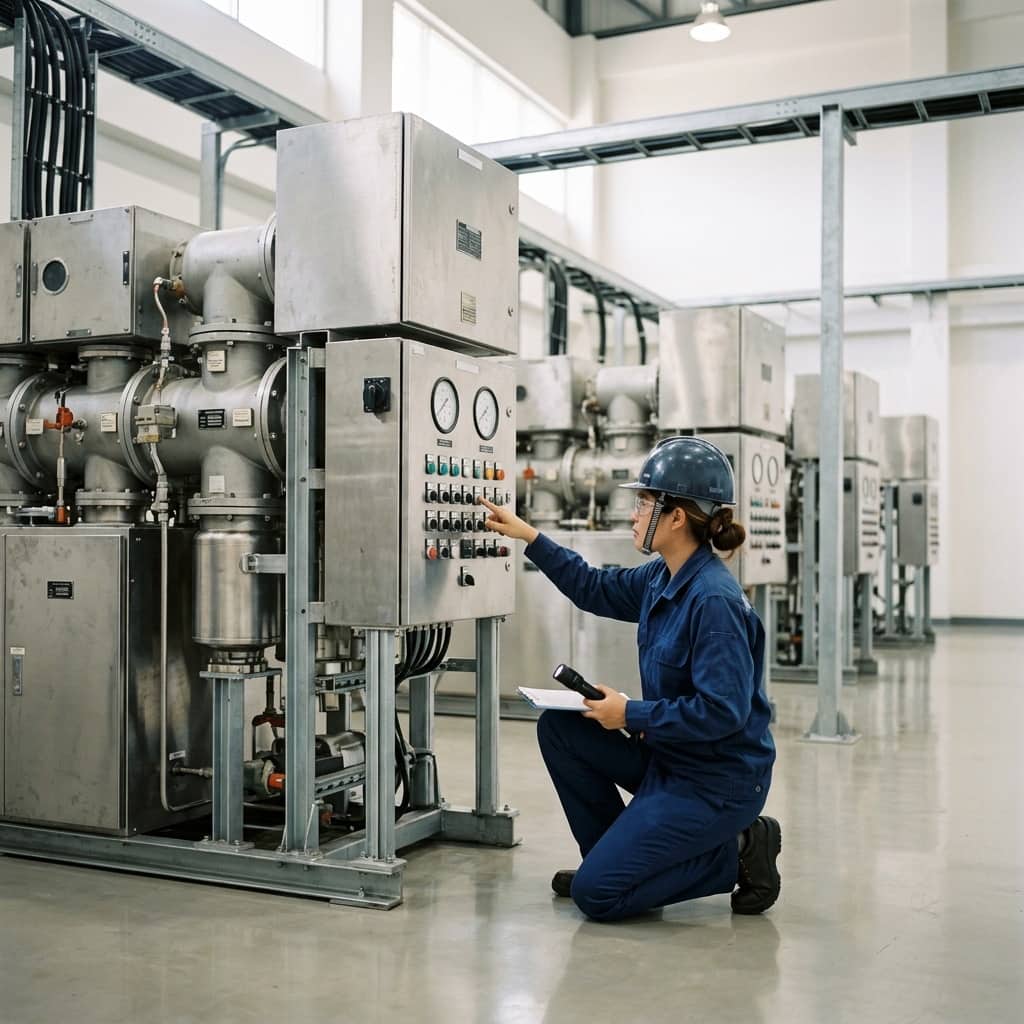
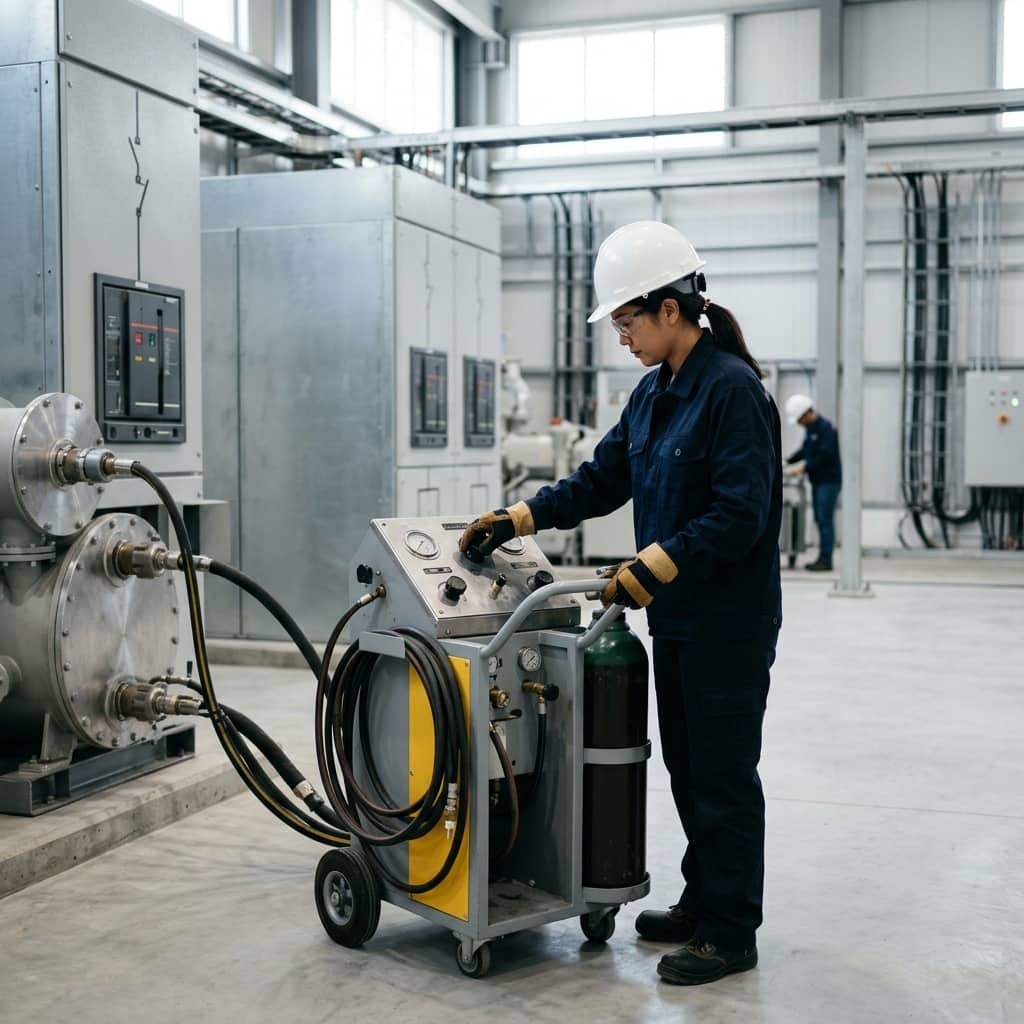
The central tool is the gas handling unit, integrating a recovery pump, vacuum pump, moisture and particle filters, a compressor for storage cylinders, and full instrumentation. Storage cylinders must be clearly segregated into good-quality gas, gas awaiting reclamation, and degraded gas awaiting destruction, with every transfer quantity logged. Systematic gas mass inventory accounting is the evidence that no gas was released to atmosphere during the work.
- IEC 62271-4 — SF6 use and handling across the lifecycle
- IEC 60480 — re-use quality criteria for used gas
- Segregate storage cylinders strictly by gas quality
- Log gas mass in and out of every transfer
3. Recovery, Vacuum Evacuation, and Refilling Procedure
Before starting, verify the gas handling unit, hoses, and couplings are clean, dry, and leak-tight. Connect to the compartment service valve with self-sealing couplings and recover gas in two stages: first letting system pressure transfer gas to storage on its own, then running the compressor to pull compartment pressure down as low as the unit allows — the lower the final pressure before opening, the less residual gas is lost.
After repair and compartment closure, the step that must never be skipped is vacuum evacuation to remove air and moisture, pumping down to the manufacturer's specified absolute pressure and holding to let adsorbed surface moisture evaporate. A vacuum hold test then confirms leak-tightness before refilling SF6 through the filter train to the temperature-corrected nominal pressure. Close out by leak-checking every joint and re-verifying gas quality after allowing the gas to stabilize.
4. Common Errors and Worker Safety
Frequent errors include vacuum evacuation cut short, leaving residual moisture that later shows up as high dew point in service; cross-contaminating good gas with hoses previously used on degraded gas; filling without temperature compensation so true pressure deviates from design; and venting hose-trapped gas when disconnecting — preventable by always recovering hose contents back into the unit before uncoupling. These small disciplines together separate near-zero-emission work from cumulatively leaky work.
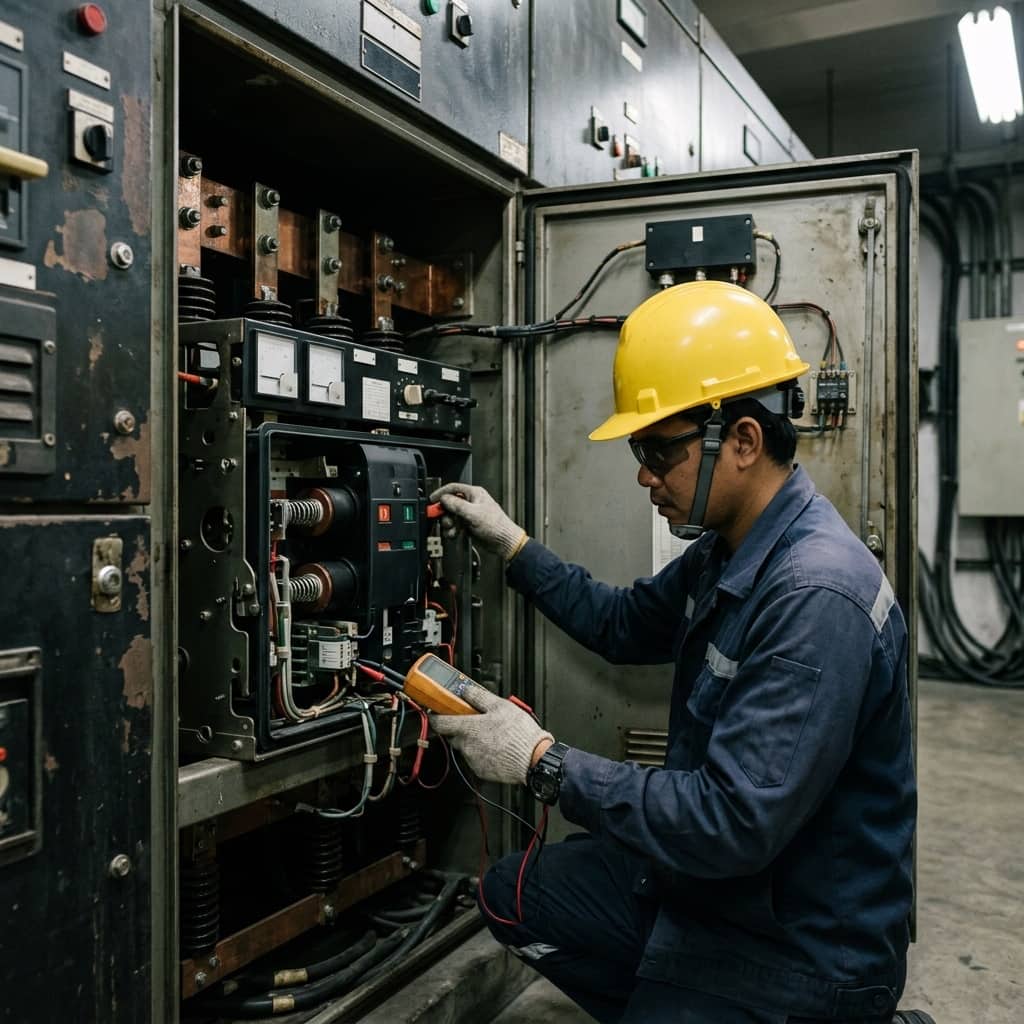
On safety: arced gas carries toxic decomposition products and metal fluoride powders. Anyone opening a compartment must wear respiratory protection, gloves, and protective clothing matched to the risk level, and clean internal powder with a fine-filtration vacuum — never compressed air. Because SF6 is much denser than air, it accumulates in cable basements and low areas, displacing oxygen; confined-space work near SF6 equipment always requires atmospheric testing before entry and continuous ventilation throughout.
- Never shorten the vacuum evacuation stage
- Segregate hoses and fittings between good and degraded gas
- Recover hose-trapped gas before every disconnection
- SF6 is denser than air — beware accumulation in low and confined spaces
Need engineering consultation regarding High Voltage?
The WIN TECH SERVICE engineering team is ready to provide site surveys, electrical system inspections, and prepare accurate legal certification reports.