Winding Surge Comparison & Hipot Testing for Industrial Electric Motors
📌 Executive Summary
Identifying inter-turn insulation weakness in AC motor stator windings before full phase-to-phase short-circuits happen.
1. The Turn-to-Turn Weakness Ordinary Tests Cannot See
A large share of motor failures begins in the turn-to-turn insulation, the thinnest insulation layer in the machine. When it weakens, shorted turns form a closed loop carrying high induced circulating current, creating intense localized heating that escalates into a phase-to-phase or ground fault in short order. The problem is that Megger insulation resistance testing only examines the winding-to-ground insulation — it is completely blind to weakness between adjacent turns sitting at nearly the same potential.
The surge comparison test was designed specifically to close this gap. The tester fires steep high-voltage impulses into each phase winding; because of the pulse's fast rise time, the voltage distributes unevenly across the first turns of the winding, stressing the turn insulation with a realistic voltage gradient. A weak spot breaks down or discharges momentarily, which appears as a detectable change in the ringing waveform.
2. Waveform Interpretation and IEEE 522
Each phase winding rings at a waveform determined by its inductance and capacitance. Interpretation therefore uses two comparisons: between the three phases of the same motor, where a healthy symmetric machine produces nearly identical overlaid waveforms, and within one phase as test voltage is gradually raised. If a turn-to-turn breakdown occurs, inductance drops abruptly and the waveform shifts to a higher frequency or visibly jumps. Modern instruments quantify the difference with metrics such as the Error Area Ratio (EAR) for systematic pass/fail decisions.
Test voltage levels follow IEEE 522, the guide for turn insulation testing of AC rotating machine windings, which relates impulse test voltage to the machine's rated voltage. The tester must choose a level appropriate to the motor's condition and age — aged in-service motors are commonly tested at more conservative levels than new machines or freshly rewound coils, balancing defect detection against the risk of accelerating damage.
- Phase-to-phase waveform comparison: a healthy motor shows near-perfect overlay
- A waveform jump or frequency shift during voltage ramp = weak turn insulation
- Use EAR values for numeric judgment rather than visual inspection alone
- Base test voltage on IEEE 522 and the motor's age and condition
3. The Complete Motor Test Sequence
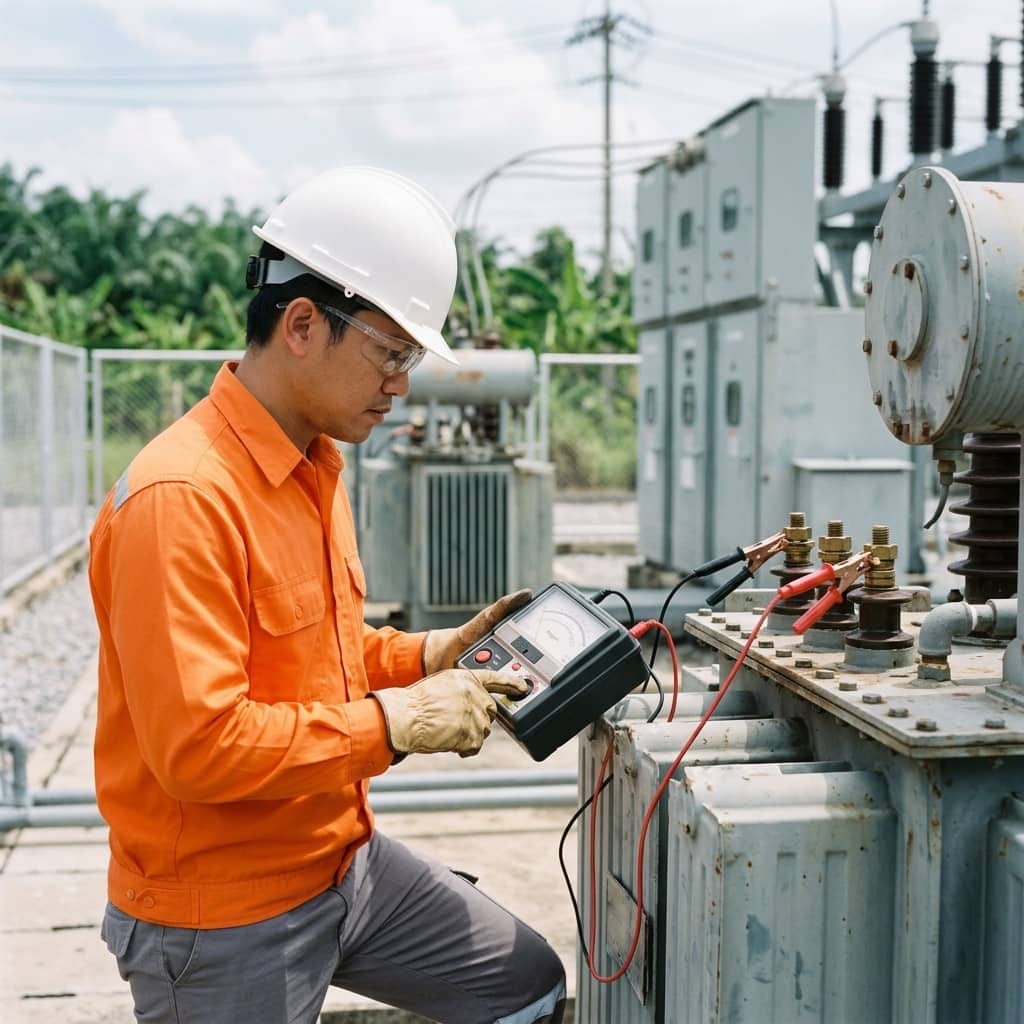
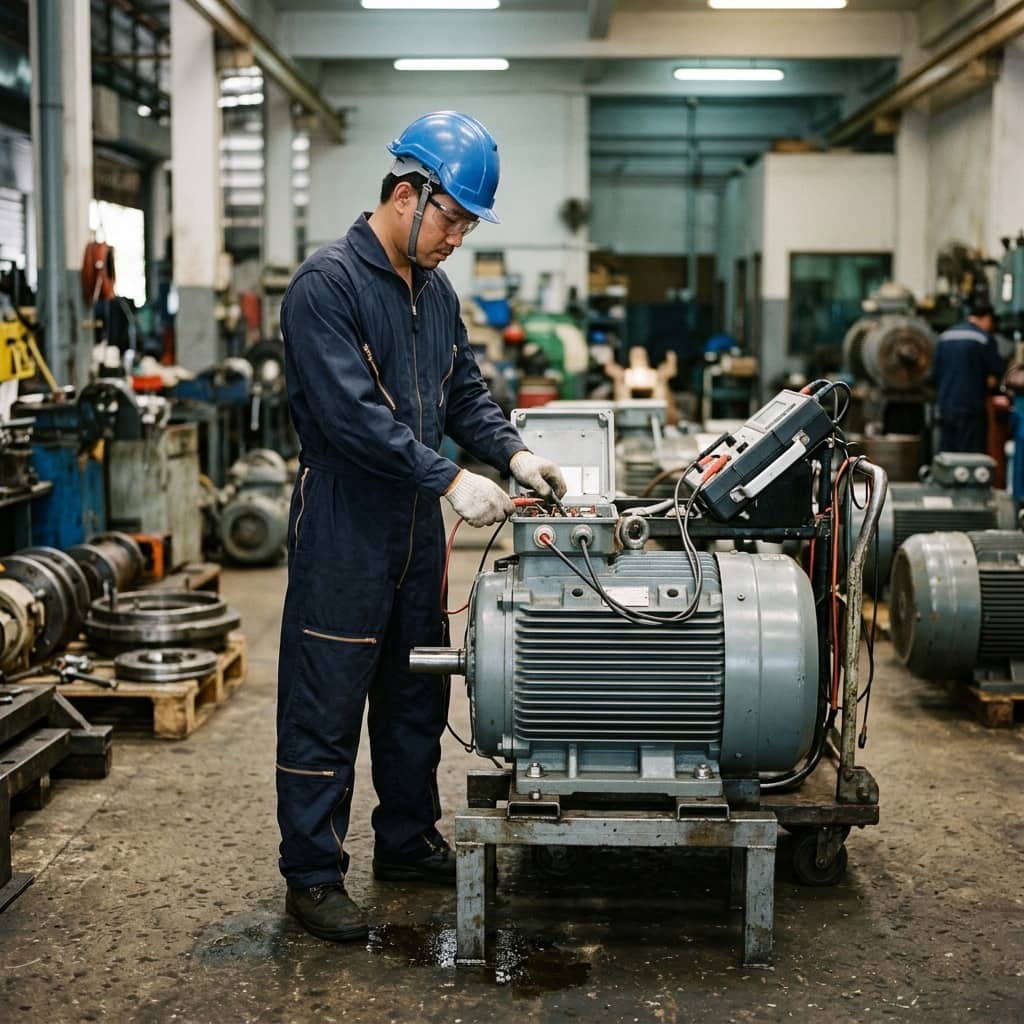
A complete winding analyzer (often generically called a Baker tester in Thai workshops after the widespread brand) combines several tests in one instrument. The correct sequence always starts with low-energy tests: winding resistance to find loose joints or open turns, three-phase inductance balance, then insulation resistance to ground with PI, followed by DC hipot to prove groundwall withstand, and finally the surge test — the most stressful — last.
This weak-to-strong ordering matters: if the winding already has a serious defect, the earlier tests catch it without subjecting it to further high-voltage stress. The full sequence should be run at scheduled PM intervals on critical motors, before deciding whether to repair or replace a misbehaving machine, and as an acceptance test every time a motor returns from a rewind shop.
4. What Degrades Winding Insulation and How to Extend Motor Life
The dominant accelerator of winding insulation aging is excess heat — as a general rule, every additional 10 degrees Celsius of winding temperature roughly halves insulation life. Causes include overload, phase voltage imbalance, excessively frequent starting, and blocked cooling passages. Motors on variable frequency drives face an additional stress: steep switching voltage pulses that particularly punish turn insulation, especially with long cable runs between drive and motor.
Life-extension measures include keeping load and power quality within ratings, cleaning cooling paths on schedule, and routinely checking three-phase voltage and current balance. For VFD-driven motors, consider dV/dt filters or inverter-duty insulation systems. Most importantly, run periodic surge tests to establish a trend — weakening turn insulation typically shows no external symptoms whatsoever until the motor burns out mid-production.
Need engineering consultation regarding Preventive Maintenance?
The WIN TECH SERVICE engineering team is ready to provide site surveys, electrical system inspections, and prepare accurate legal certification reports.