Step-Up Transformer Selection for Megawatt Scale Solar Farms (0.8kV to 22kV/115kV)
📌 Executive Summary
Designing inverter duty transformers withstand harmonic heating, DC bias, and frequent thermal cycling in solar farms.
1. The Role of the Step-Up Transformer in a Solar Farm
A megawatt-scale solar farm generates at low voltage from its inverters but must deliver energy into the utility network at medium or high voltage, such as the 22 kV or 33 kV distribution levels. The step-up transformer is the device through which all project energy flows — its losses or downtime hit revenue every hour. Sizing and specifying it is among the weightiest engineering decisions in the project.
Transformer loading in solar service differs from typical factory duty: it cycles daily with the sun, peaking at midday and dropping to zero at night, and the current carries harmonic content from the inverters, which heats the windings more than a pure sinusoid of the same rating. Selecting a transformer on nameplate power alone, without considering the real thermal cycle and harmonic effects, risks insulation aging faster than design.
2. Transformer Standards and HV Interconnection Requirements
Power transformers follow the IEC 60076 series, covering general requirements, overvoltage withstand, temperature-rise limits, and the routine and type tests a buyer should specify explicitly in procurement — no-load and load loss measurement, impulse withstand testing, and factory acceptance test reports. For connection into the utility network, the transformer and substation must meet the interconnection requirements and equipment specifications PEA or MEA accept at that voltage level.
Projects selling electricity commercially also fall under the Energy Regulatory Commission (ERC), which governs licensing and engineering safety standards for power plants. Substation design therefore layers multiple requirement sets: equipment standards, station protection schemes, electrical clearances, transformer oil containment for environmental protection, and installation practice per EIT standards.
- Specify against the IEC 60076 series
- Define routine/type tests and FAT reports in procurement
- Equipment and interconnection per PEA/MEA requirements
- Operating license under ERC supervision
- Oil containment and clearances per EIT guidance
3. Sizing Approach and Technical Specification
Sizing starts from the maximum AC power of the inverter group connected to each transformer, informed by the project's DC/AC ratio, which determines how many hours per day the transformer runs near rating. Impedance must balance short-circuit current limitation against voltage drop under load, while the vector group and neutral earthing must be designed together with the station's overall protection scheme.
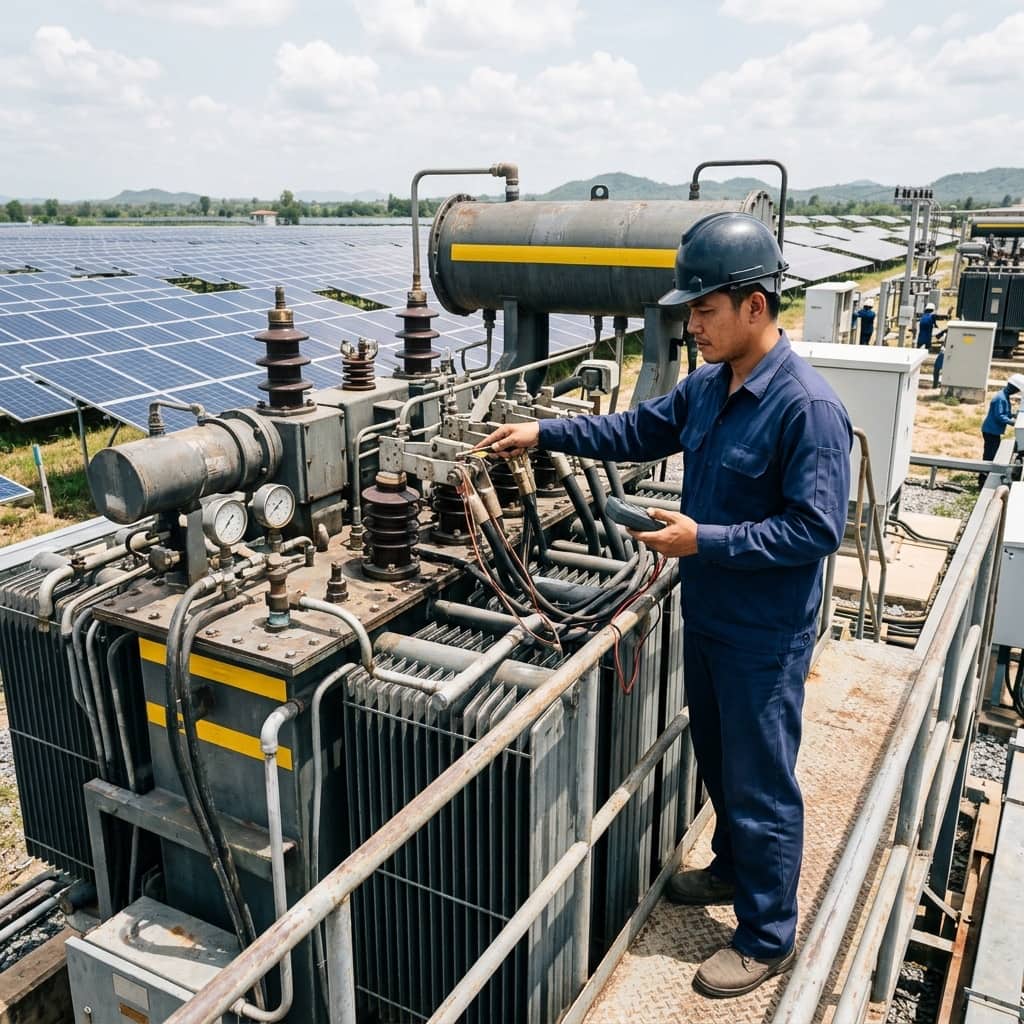
Solar-specific properties to specify include tolerance for inverter harmonic currents; cooling suited to the site's real ambient temperatures; monitoring devices such as oil and winding temperature gauges, a Buchholz relay, and pressure relief valves; and consideration of low-loss designs — no-load loss runs 24 hours a day, including revenue-less nights. Evaluating lifetime loss value should therefore be part of comparing procurement offers.
4. Acceptance, Maintenance, and Common Problems
Before energization, a full site test suite is required: insulation resistance, turns ratio, winding resistance, transformer oil tests for dielectric strength and moisture, and verification of every protective device operating with the station relays. This first result set is the baseline for comparison across the service life — invaluable for diagnosing future abnormalities.
Common solar-farm transformer problems include heat accumulation at summer midday from under-margined cooling, oil aging faster than expected under daily cyclic duty, and hot bushing connections from sub-standard torquing. Effective maintenance rests on scheduled dissolved gas analysis (DGA) to catch internal faults early, thermal imaging of external connections at high load, and annual oil testing trended against the baseline retained from acceptance day.
- Keep acceptance-day results as the lifetime baseline
- Perform dissolved gas analysis (DGA) on schedule
- Thermal-scan external connections at high load
- Test oil annually and trend against the baseline
Need engineering consultation regarding Solar & Clean Energy?
The WIN TECH SERVICE engineering team is ready to provide site surveys, electrical system inspections, and prepare accurate legal certification reports.