High Voltage & Medium Voltage Busduct Trunking Installation Guide
📌 Executive Summary
Torque control for joint bolts, insulation resistance testing, and thermal scanning on sandwich-type MV busducts.
1. What Busducts Are and Why They Replace Multiple Cables
A busduct (busway) is a prefabricated power transmission system of insulated copper or aluminum bars inside a metal enclosure, used to connect transformers to switchgear or carry large power vertically through high-rise buildings. Compared with multiple parallel cables, it carries high current in limited space, withstands short-circuit forces well because conductors are rigidly braced, installs as an orderly and inspectable system, and eliminates the congestion of many cable terminations at equipment terminals.
Sandwich-type busduct, with phase conductors stacked closely with insulation between them, dominates modern low- and medium-voltage practice thanks to its compactness and low impedance. Yet what decides system reliability is not the factory-made straight lengths but the field-assembled joints and installation workmanship — bolt torque, support, and water protection. Most busduct failure experience traces back to installation and joints almost without exception.
2. Product Standards and Installation Design Considerations
Low-voltage busduct is a type-tested assembly under IEC 61439-6, which prescribes verification of short-circuit withstand, temperature rise, and enclosure ingress protection (IP rating); medium-voltage systems follow the IEC 62271 series testing framework. Application choices must consider current rating at the actual ambient temperature, IP level suited to the location — outdoors or in shafts subject to water leakage — and expansion units where runs are long or cross building expansion joints.
Route design must place supports at manufacturer-specified intervals, keep joints out of inaccessible positions since they must be opened for inspection and torque verification in the future, install tested fire barrier assemblies at every fire-rated floor or wall penetration, and use spring hangers on high-rise vertical runs so accumulated weight does not bear on the lowest section. These details belong in the construction drawings, not in improvised fixes on site.
- IEC 61439-6 — type-tested low-voltage busduct assemblies
- Choose IP rating for the actual installed environment
- Every joint must remain accessible for future inspection
- Fit tested fire barriers at fire-rated penetrations
- Use spring hangers on high-rise vertical runs
3. Joint Assembly and Pre-Energization Testing
Modern busduct joints mostly use a single large bolt with a torque-indicating washer or shear head, engineered to deliver correct clamping force when the head shears off at the proper torque. Impact tools and re-tightening after shear are prohibited. Before assembly, contact surfaces must be clean of dust and oil films, sections aligned so the joint carries no residual twisting force, and joint covers fitted complete with gaskets per the drawings. Each joint should be logged by number, location, and assembler for traceability.
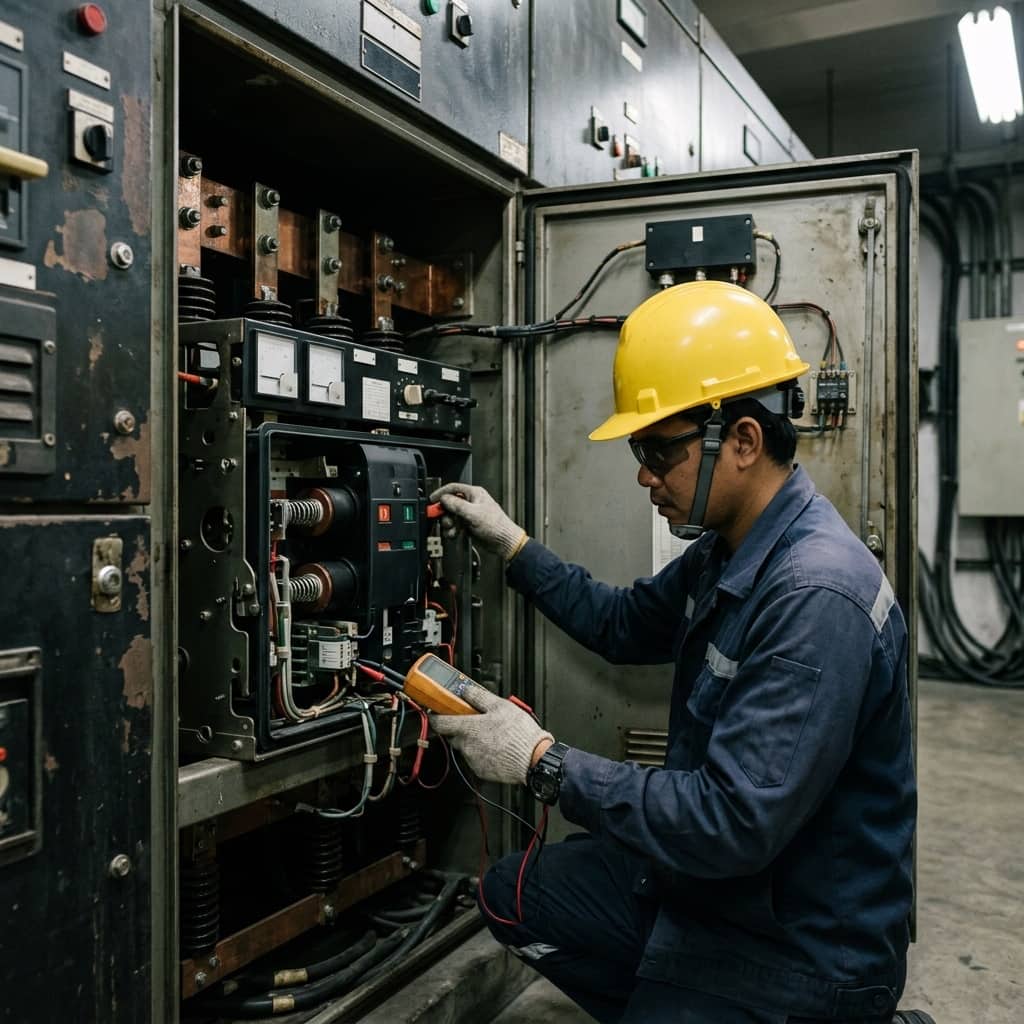
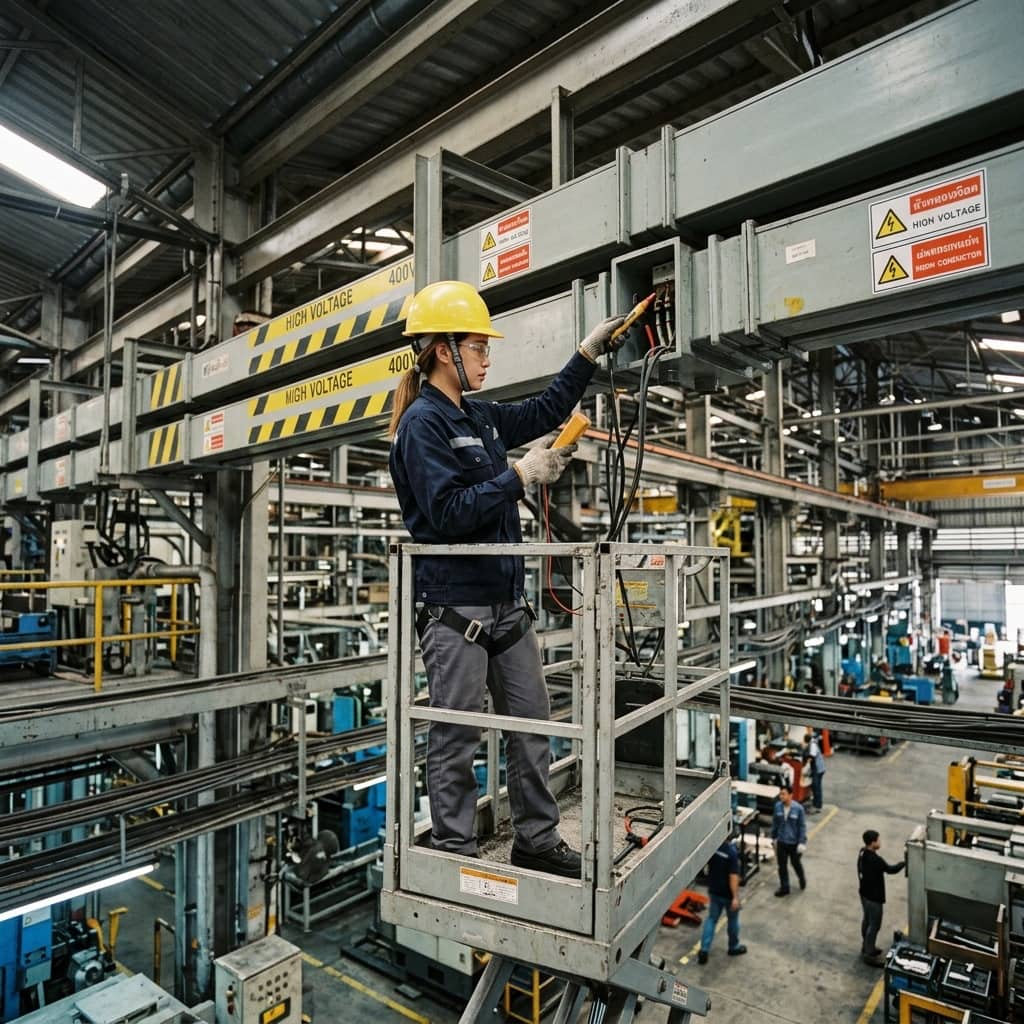
Before energization, measure insulation resistance phase-to-phase and phase-to-earth at the appropriate megohmmeter voltage, recording values with reference temperature and humidity; verify continuity of the earth conductor or enclosure used as the fault return path; and confirm phase sequence at both ends. For critical systems, record baseline joint resistances with a micro-ohmmeter. Once under real load, thermally scan every joint early in service — a defectively assembled joint reveals itself as a hot spot from the first loading.
4. Common Failure Causes and Periodic Maintenance
The number-one killer of busducts is water — roof leaks along the route, plumbing work on floors above, or condensation inside the enclosure under high humidity and rapid temperature swings. Water reaching a joint degrades insulation until a phase-to-phase flashover occurs, usually with severe damage given the high fault energy available. Next come loose joints from improper assembly or accumulated vibration, and conductive dust build-up inside ventilated designs.
Periodic maintenance includes thermal scanning of joints and tap-offs under high load at least annually, walking the route to inspect for water traces and mechanical damage, insulation resistance measurement against baseline at planned outages, checking joint torque-indicating washers through inspection windows without dismantling covers, and re-verifying building penetration seals whenever nearby renovation occurs. This preventive vigilance costs very little compared with a flashover in the main power artery, which can instantly black out an entire building.
- Water is the leading cause of busduct failure
- Thermally scan joints under high load at least yearly
- Inspect the route after any roof or upstairs plumbing work
- Compare insulation resistance to baseline at every outage
Need engineering consultation regarding High Voltage?
The WIN TECH SERVICE engineering team is ready to provide site surveys, electrical system inspections, and prepare accurate legal certification reports.