Battery Energy Storage Systems (BESS) for Factory Peak Shaving & TOU Optimization
📌 Executive Summary
Using Industrial Lithium-Ion BESS to charge during Off-Peak hours and discharge during Peak rate periods for massive utility savings.
1. The Principle of Peak Shaving with Battery Storage
Thailand's tariff structure for medium and large business customers includes a demand charge computed from the month's maximum power demand. A battery energy storage system (BESS) reduces this cost through peak shaving: discharging the battery during plant load spikes to lower the peak the utility meter records, then recharging while load is low.
Peak shaving succeeds or fails on load profile analysis before design. Engineers should collect load data at 15-minute resolution to match the utility's demand billing interval, spanning at least the plant's seasonal production cycle, to characterize the peaks — their height, frequency, and duration. This data directly sizes the system's power (kW) and energy (kWh): short sharp peaks need high power with modest capacity, while long sustained peaks demand large energy capacity.
2. BESS Safety Standards and Interconnection Requirements
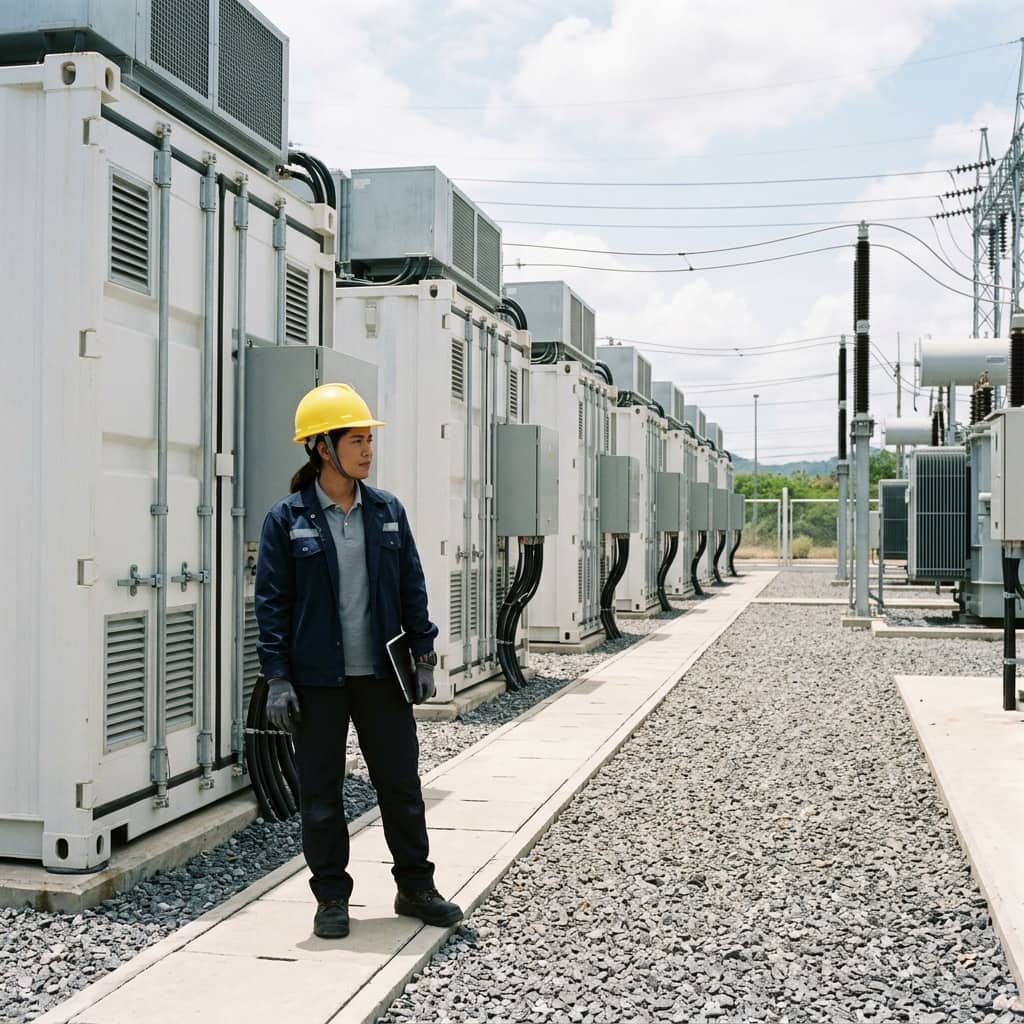
Lithium-ion batteries, the dominant BESS technology, carry a specific hazard: thermal runaway. Product selection should therefore weigh certification to international standards such as IEC 62619 for the safety of lithium cells and batteries in industrial applications, and system-level thermal propagation test approaches such as UL 9540A, which inform spacing, detection, and fire suppression design for battery rooms or cabinets.
On the interconnection side, a BESS paralleled with the grid through a bidirectional power conversion system (PCS) falls under the same PEA/MEA generator interconnection requirements as solar systems. The installer must apply for connection approval, submit protection drawings, and configure protection functions per the code. Where the design is non-export, the control system must demonstrably prevent battery power from flowing out of the facility under every operating condition.
- IEC 62619: safety of industrial lithium batteries
- UL 9540A: system-level thermal propagation testing
- PEA/MEA generator interconnection requirements
- Non-export control provable in all conditions
- Battery-specific detection and fire suppression design
3. Sizing Methodology and Control Strategy Setup
Sizing begins with simulation against historical load data, testing several peak-target levels and computing the energy the battery must deliver in each event, to find the balance between system size and demand-charge savings. Capacity margins must cover the depth of discharge appropriate to battery life, year-on-year capacity fade, and round-trip efficiency — otherwise the system will fail to hold the peak in the project's later years.
The operating control strategy needs a real-time load meter feeding the controller so it can discharge the moment load approaches the target. The commonly overlooked details are recharge conditions — which must not create a new peak themselves — and coordination with any solar system so surplus PV energy charges the battery first. After installation, test against real peak events and re-tune the target during the first months of operation.
4. Operational Cautions and BESS Maintenance
Common operational problems include setting the peak target too low so the battery empties before the peak ends — costing the full month's demand charge at the new peak; recharging at moments that stack onto high load and create a new peak; and ignoring battery management system (BMS) warnings such as cell imbalance or abnormal temperature, which are early signals of both degradation and safety risk.
Maintenance should cover the battery enclosure's cooling system, verification of smoke and gas detection, testing of the emergency shutdown sequence, and regular BMS data analysis to track capacity fade against design. As real capacity declines, adjust the control strategy accordingly — for example raising the peak target to match remaining capacity — to keep peak shaving reliable across the project's life.
- Do not set the peak target below what battery energy can sustain
- Time recharging so it never creates a new peak
- Monitor BMS warnings consistently
- Re-tune the control strategy as capacity fades each year
Need engineering consultation regarding Solar & Clean Energy?
The WIN TECH SERVICE engineering team is ready to provide site surveys, electrical system inspections, and prepare accurate legal certification reports.