External Lightning Protection System (LPS) Design per IEC 62305 & EIT 2003
📌 Executive Summary
Rolling sphere method, mesh method, air termination rod placement, down conductors, and equipotential bonding.
1. Why External Lightning Protection Matters
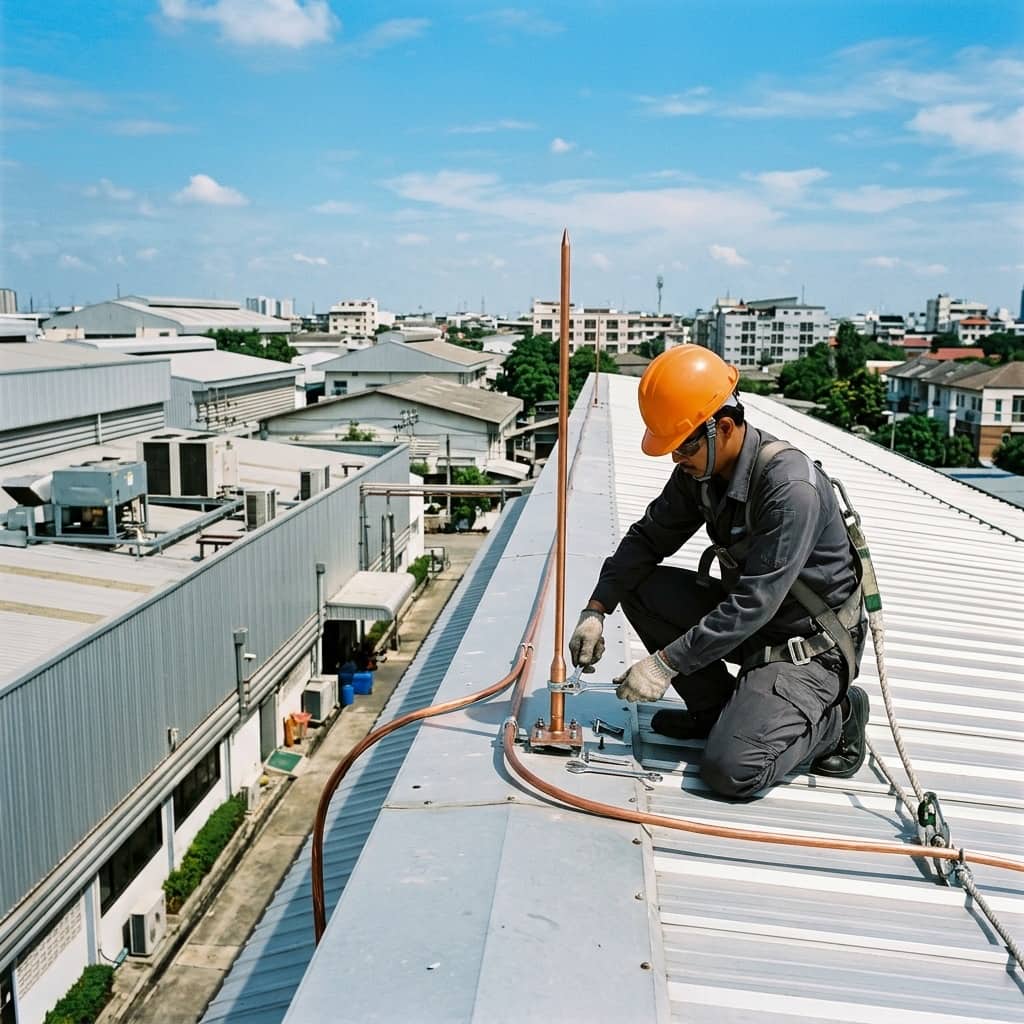
A lightning strike releases tens of kiloamperes of current within microseconds. Without a properly designed Lightning Protection System (LPS), the discharge will find its own path to ground through the building structure, piping, or internal electrical systems — endangering lives, starting fires, and damaging electronics on a wide scale. An external LPS performs three functions: intercepting the strike at air termination devices, conducting the current safely down the building via down conductors, and dissipating the charge into the soil through the earth termination system.
Design under IEC 62305 begins with a risk assessment that determines the required class of LPS (Class I through IV), considering local ground flash density, building size and height, occupancy and usage, and the tolerable level of loss. The selected class then fixes every design parameter — rolling sphere radius, mesh size, and down conductor spacing among them. Skipping the risk assessment and designing by habit therefore risks both under-protection and unnecessary over-investment.
2. Air Termination Placement: Rolling Sphere and Mesh Methods
The rolling sphere method is the primary tool for verifying air terminal placement. A sphere with a radius set by the LPS class — for example 20 m for Class I, 30 m for Class II, 45 m for Class III, and 60 m for Class IV — is imagined rolling over and around the building; any point the sphere surface can touch is a possible strike point and must be protected by an air termination. The method excels on complex geometries: protrusions, multi-level roofs, and rooftop equipment such as water tanks, ventilation units, and antenna masts.
For large flat roofs, the mesh method is commonly used: conductors are laid out in a grid whose cell size the standard prescribes per class, from 5×5 m for Class I up to 20×20 m for Class IV, supplemented with short air rods along roof edges and corners — statistically the most frequent strike points. Both methods may be combined on one building, and the protective angle method can supplement them for lower structures or individual rooftop items. In all cases the separation distance from internal conductive systems must be checked.
- Rolling sphere radius: Class I = 20 m, Class II = 30 m, Class III = 45 m, Class IV = 60 m
- Mesh size: from 5×5 m for Class I up to 20×20 m for Class IV
- Add air rods at roof edges and corners, the most frequent strike points
- Every rooftop item must sit within a protected zone or carry its own air termination
- Always verify the separation distance from internal conductive systems
3. Down Conductors, Earth Termination, and Equipotential Bonding
Down conductors must give the lightning current multiple parallel paths that are as short and straight as possible, avoiding tight bends where high induced voltages can cause side flashes. Their spacing around the building perimeter follows the LPS class — for example every 10 m for Class I up to every 20 m for Class IV — and structural rebar or steel columns may serve as natural down conductors when their electrical continuity can be proven.
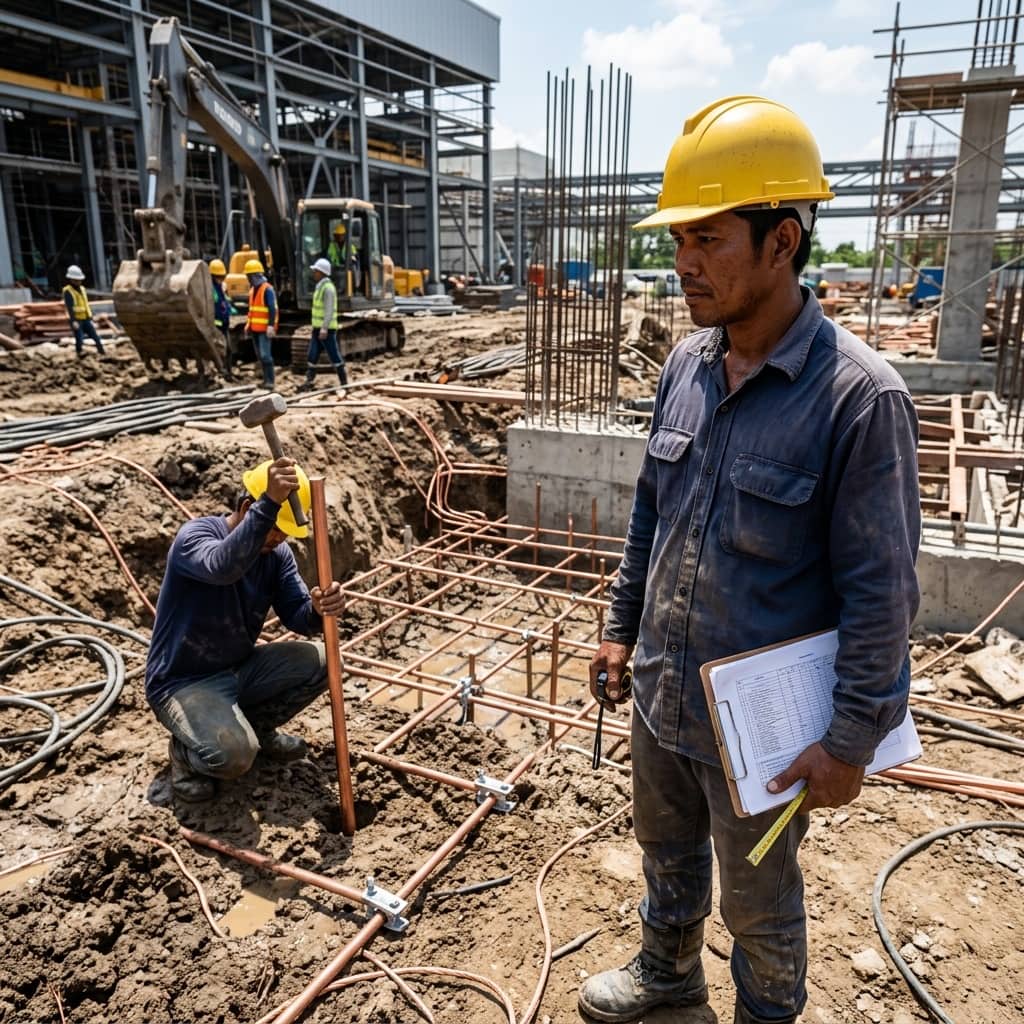
The earth termination is designed either as a ring electrode around the building (Type B) or as discrete driven rods (Type A) depending on soil and building characteristics, with emphasis on the geometry of current dissipation rather than a single resistance figure. Equally critical is lightning equipotential bonding: connecting the LPS to the building's main bonding bar and installing appropriately rated surge protective devices (SPDs) in distribution boards, so that transient overvoltages do not destroy the electronics inside the facility.
4. Frequently Found Defects and Maintenance
Inspections of aging LPS installations repeatedly reveal the same defects: down conductors severed during building renovations, test joints painted over or seized so they can no longer be opened for measurement, roof conductors detached from their fixings by heat and wind, and new rooftop equipment — air conditioning units or solar panels — installed without re-checking the protection zones, unintentionally turning that equipment into strike points.
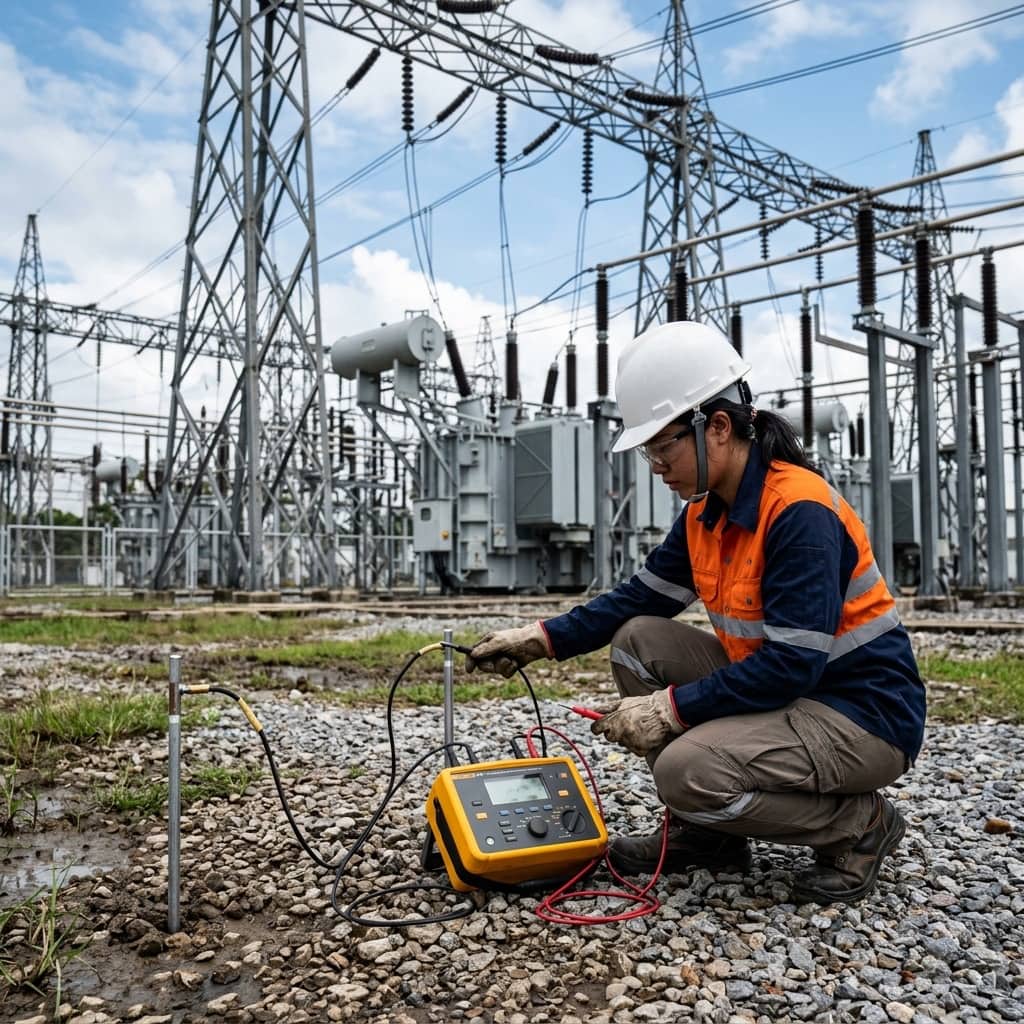
Good practice is a visual inspection at least annually and a full electrical verification at the interval the standard recommends for each LPS class: continuity measurement of every conductor path, opening each test joint to measure individual electrode resistance, and checking SPDs for degradation from accumulated surge duty. Whenever roof work or new equipment installation is planned, an engineer should re-run the rolling sphere analysis and confirm the protection zones before the work is approved.
Need engineering consultation regarding Safety & Grounding?
The WIN TECH SERVICE engineering team is ready to provide site surveys, electrical system inspections, and prepare accurate legal certification reports.