Harmonic Distortion & Power Factor Impact of Large EV Charging Hubs
📌 Executive Summary
Evaluating THDi generated by active front-end rectifiers in fast chargers and specifying active harmonic filters (AHF).
1. How EV Charging Stations Affect Power Quality
Every DC charger contains rectifiers that draw non-sinusoidal current from the AC system, injecting harmonic currents back into the network. With many chargers operating simultaneously, the combined harmonics can distort the system voltage, affecting other loads on the same transformer: motors run hotter, electronics misbehave, and existing power factor correction capacitors can suffer overcurrent through resonance. Harmonics also add losses in transformers, sometimes forcing derating of their usable capacity.
The principal metrics are total harmonic distortion of current (THDi) and of voltage (THDv). Modern chargers with active front-end technology exhibit significantly lower THDi than older 6-pulse or 12-pulse rectifier designs. Reading this part of the specification at procurement is the cheapest power quality control available — remediating afterward with filters always costs more.
2. Standards Criteria and Utility Requirements
The widely used international reference for harmonics at the point of common coupling (PCC) is IEEE 519, which caps current distortion according to the load's size relative to system strength and voltage distortion according to system voltage level. In Thailand, both MEA and PEA maintain power quality requirements on harmonics for customers connecting to the distribution system, and applicants for large charging stations must demonstrate compliance by assessment or measurement.
Power factor is the companion dimension. Thai tariff structures for medium and large business customers include penalties when reactive power demand exceeds the prescribed proportion. Most modern chargers control input power factor close to unity, but light-load behavior in some models differs from the full-load specification, so field measurement across several load levels is necessary before declaring compliance. Beware of adding plain power factor correction capacitors to a harmonic-rich system — the resonance risk means detuned reactor equipped banks should always be used.
- Assess harmonics at the PCC per IEEE 519 guidance
- Comply with MEA / PEA power quality requirements at connection
- Measure real power factor across load levels, not only at full rating
- PF correction capacitors in harmonic-rich systems need detuned reactors
3. Measurement and Harmonic Filter Selection
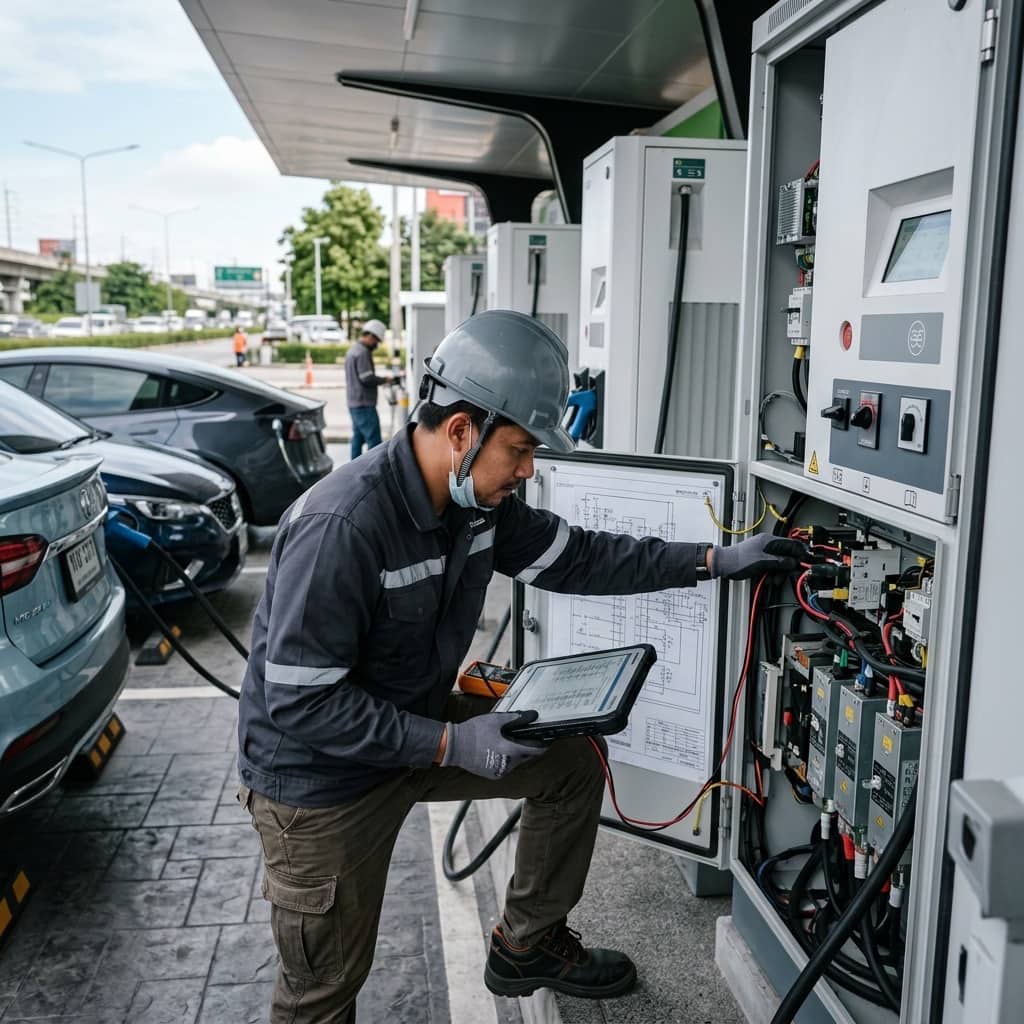
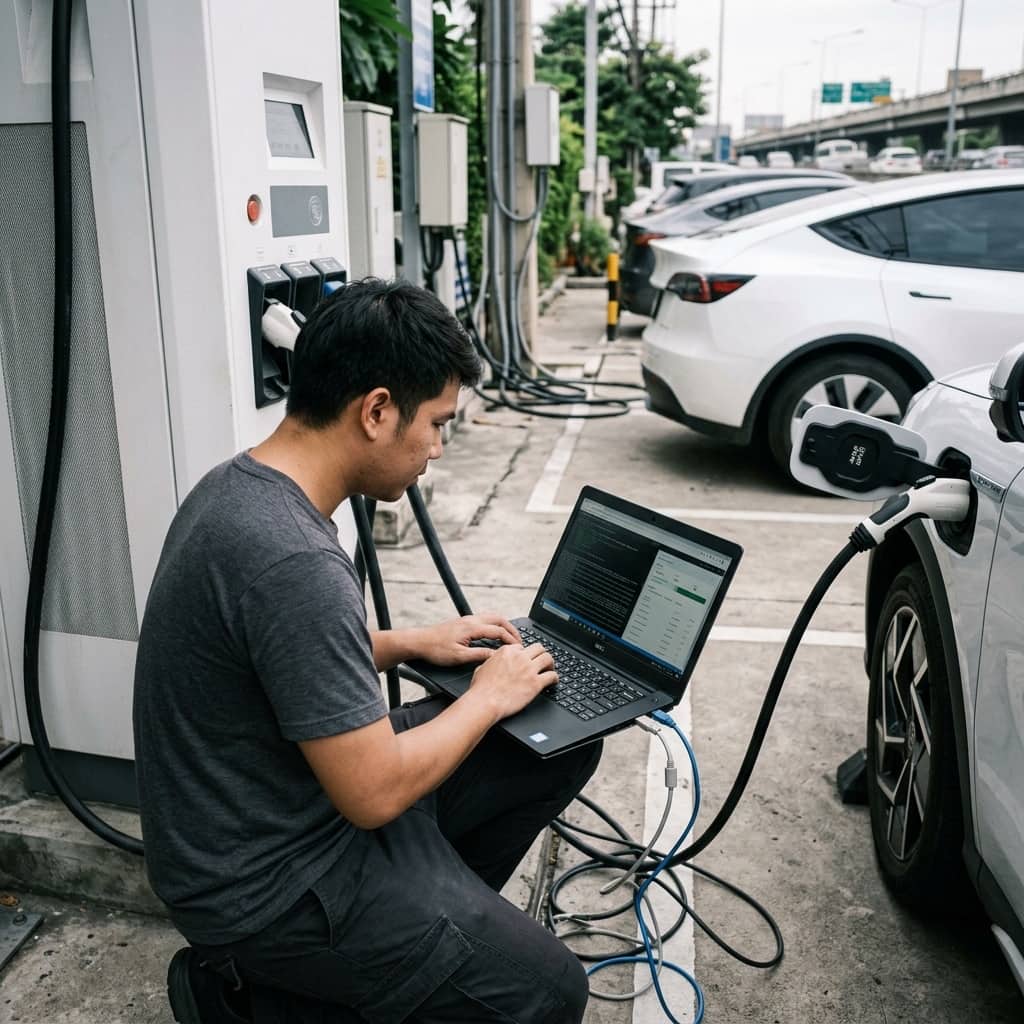
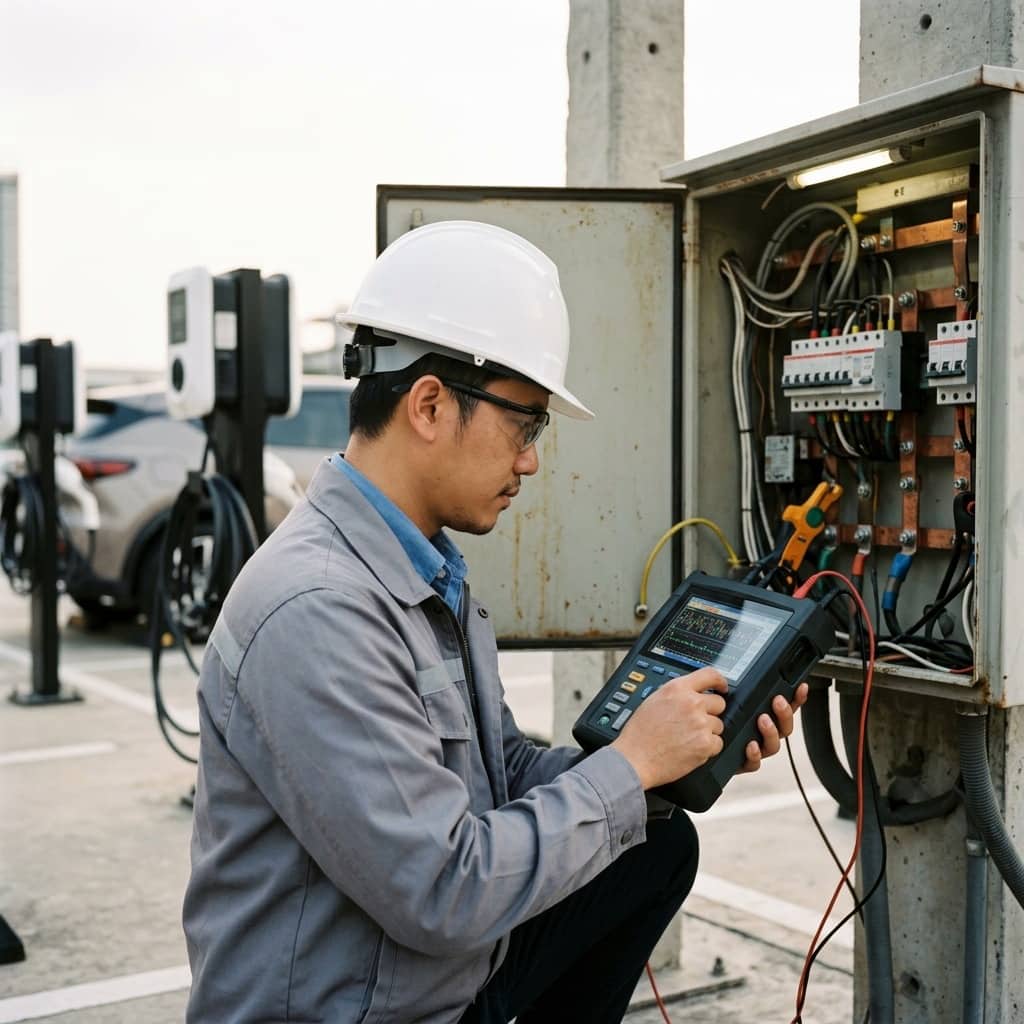
Proper measurement uses a power quality analyzer conforming to the IEC 61000-4-30 instrument standard, recording continuously for at least a week to capture all load behaviors — rush hours with many chargers running simultaneously as well as light-load periods. Measurement points should cover both the transformer's low-voltage side and the charger group feeders, distinguishing distortion contributed by the station from distortion pre-existing on the network from other loads. The resulting per-order harmonic spectrum is the basis for a targeted remedy.
When results exceed criteria, the primary remedy is the active harmonic filter (AHF), which injects cancelling currents in real time and adapts well to the constantly varying load of a charging station. AHF sizing is based on the total harmonic current in amperes to be cancelled per the actual measurements, with allowance for station expansion. Passive filters tuned to specific orders cost less but demand a careful system resonance study. K-factor rated transformers or generous transformer sizing are complementary equipment-side measures best considered when designing a new station.
- Use an IEC 61000-4-30 compliant analyzer recording at least one week
- Measure both the transformer LV side and the charger group feeders
- Size the AHF from measured harmonic current with expansion margin
- Study system resonance before installing passive filters
4. Recurring Problem Patterns and Systemic Fixes
The recurring pattern in fast-growing stations is adding chargers one at a time without ever reassessing cumulative harmonics — until protective devices trip without apparent cause, transformers run hot despite metered load below rating, or the building's existing power factor capacitors fail repeatedly. These are all signatures of harmonics accumulating past what the system tolerates. Another case is an installed AHF configured without covering every significant harmonic order, so post-installation measurements improve less than targeted.
The systemic fix is making power quality assessment a mandatory step for every charger addition, not a one-off at station opening. Install a permanent power quality meter at the main board to trend THD and power factor continuously with alarms approaching limits, review AHF settings whenever the load structure changes, and file annual measurements alongside maintenance reports as one dataset. This turns power quality from reactive firefighting into genuinely foreseeable risk management.
Need engineering consultation regarding EV Infrastructure?
The WIN TECH SERVICE engineering team is ready to provide site surveys, electrical system inspections, and prepare accurate legal certification reports.