Grounding Standards & PEN Fault Protection for EV Charging Stations
📌 Executive Summary
Ensuring compliance with IEC 60364-7-722 for earth electrode resistance <= 5 Ohms and TT/TN-S earthing configurations.
1. Why Earthing Determines User Safety at Charging Stations
What sets an EV charging station apart from ordinary electrical equipment is that the user grips the charging connector and touches the vehicle body directly, outdoors, and often on wet ground or in the rain. If the earthing system is defective, the touch voltage appearing on the vehicle body can be lethal. Charging station earthing must therefore be designed and field-verified more rigorously than a typical installation, the objective being a low-impedance return path for fault current so protective devices disconnect in time.
The specific hazard of TN-C-S systems, where the supply combines neutral and earth in a PEN conductor, is a broken PEN (open PEN) event. When it occurs, every exposed metal part bonded to the system earth — including the EV body — rises toward phase voltage while ordinary breakers and RCDs do not trip, because there is no residual current to detect. This is why international standards impose measures specific to EV charging circuits beyond those of general household circuits.
2. IEC 60364-7-722 Requirements and Thai Practice
IEC 60364-7-722, covering electrical installations for EV supply circuits, requires each connecting point to have a dedicated circuit with its own residual current protection — either an RCD Type B, or an RCD Type A combined with a 6mA DC residual current detecting device (RDC-DD) — to handle DC leakage from vehicle power electronics that can blind an ordinary RCD. In Thailand, the EIT electrical installation standard incorporates EV supply equipment requirements aligned with the IEC approach and with MEA and PEA utility practice.
In Thai installation practice, designers commonly configure the charging circuit earthing as TT with its own dedicated earth electrode, or as TN-S with earth and neutral strictly separated from the origin, adding a supplementary electrode at the charger location. The commonly applied acceptance criterion for electrode resistance is not more than 5 ohms, consistent with utility practice. This must be verified by actual measurement with an earth resistance tester and documented in the handover records — never estimated from soil type without measuring.
- Every connector requires a dedicated circuit with its own RCD
- Use RCD Type B, or Type A plus a 6mA DC-detecting RDC-DD
- Practice criterion for earth electrode resistance: 5 ohms or less, measured
- Consider TT or TN-S arrangements to mitigate broken-PEN risk
3. Electrode Installation and Field Testing
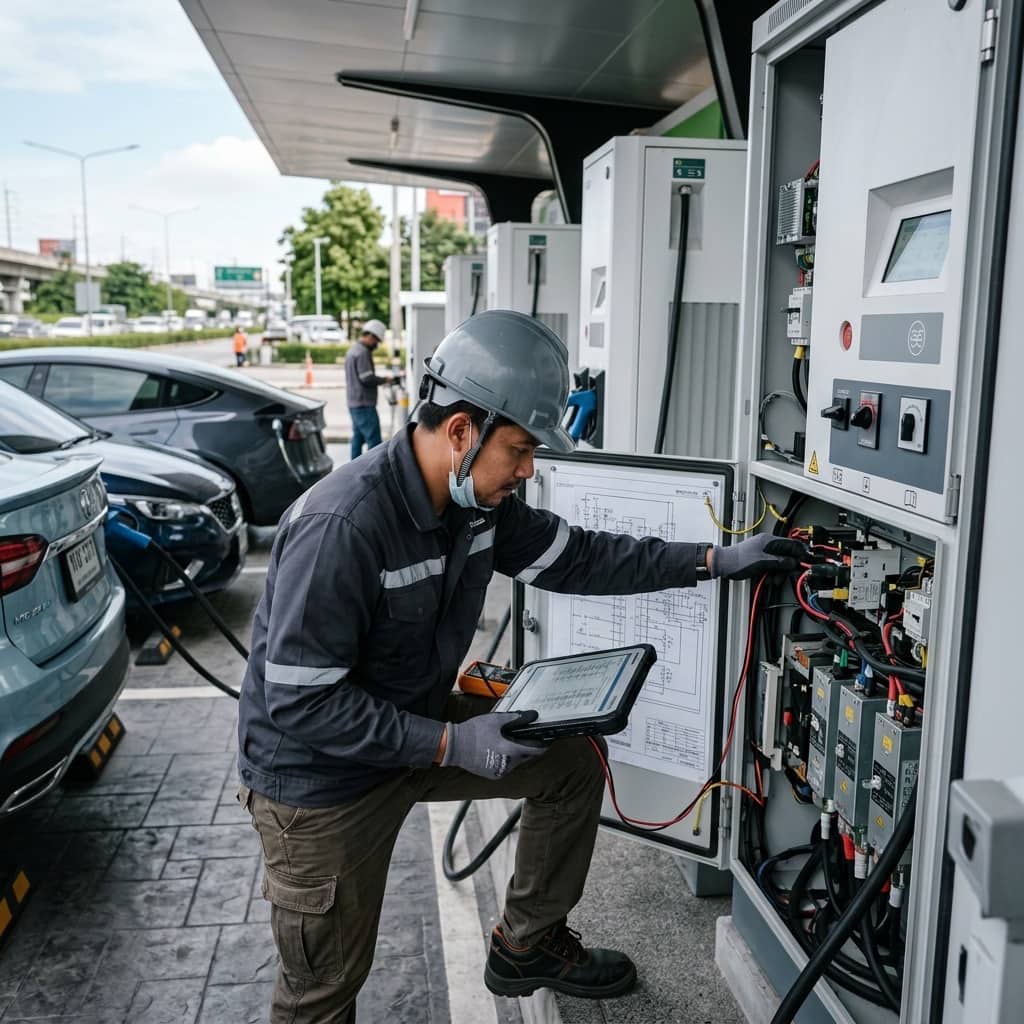
Electrode work begins with driving standard copper or copper-bonded rods to the required depth, then measuring resistance using the three-point fall-of-potential method. If the result exceeds the criterion, add rods spaced no closer than one rod length apart, or apply ground enhancement material. Connections between the earthing conductor and the rods should use exothermic welding or certified, inspectable clamps.
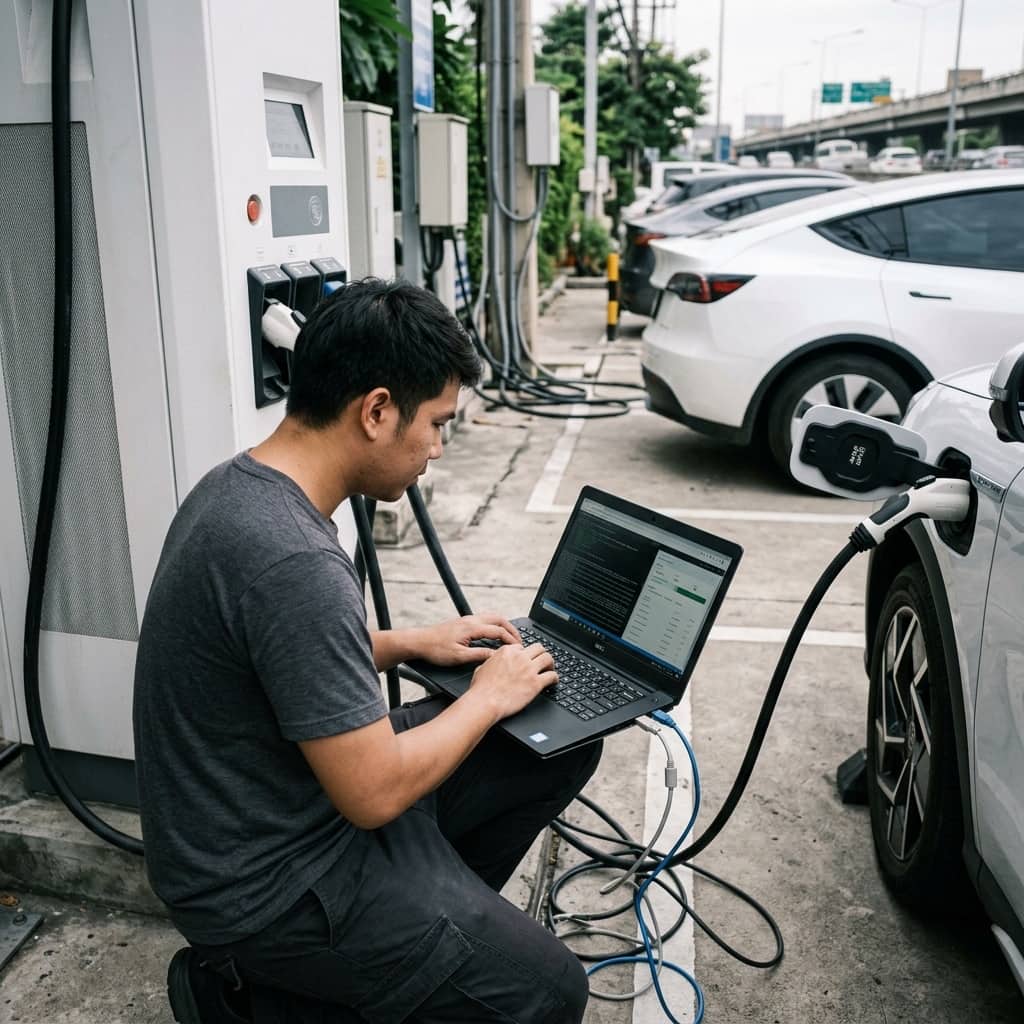
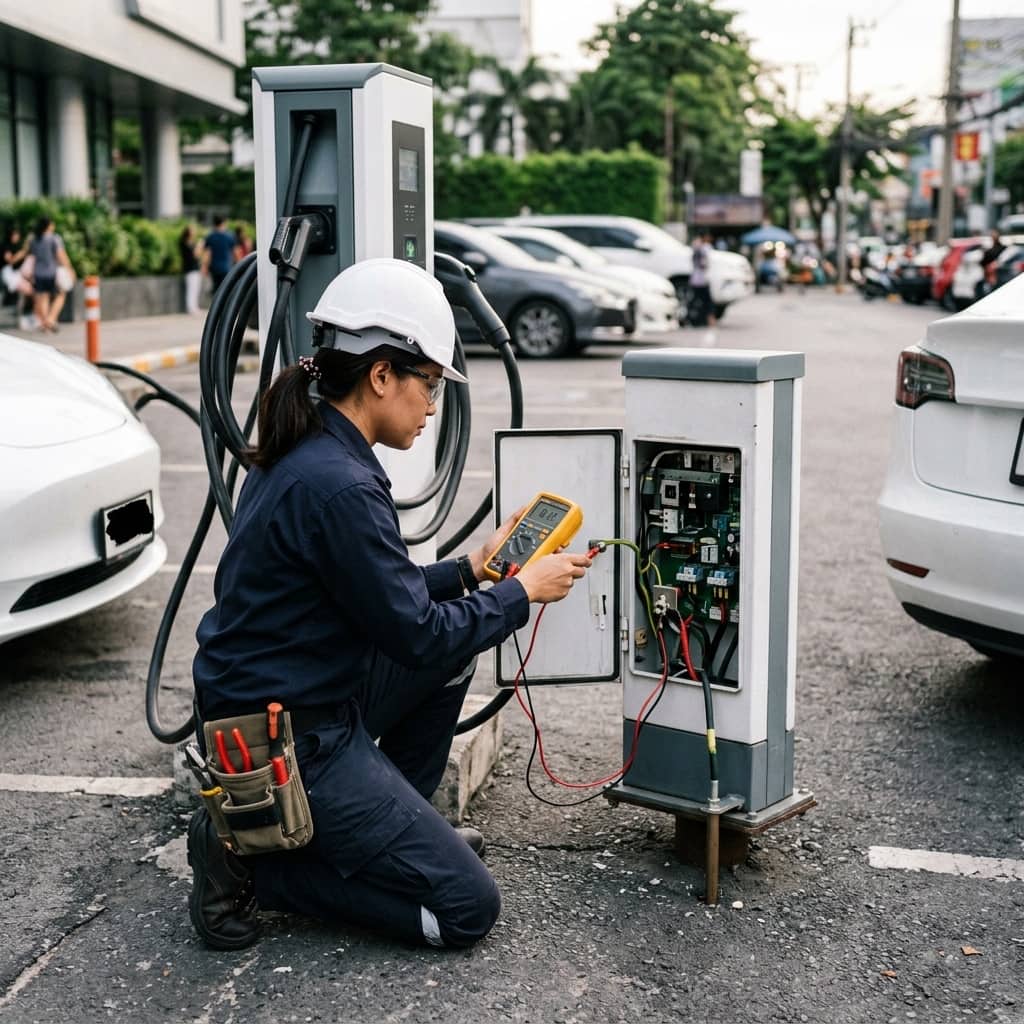
Pre-commissioning testing must go beyond the electrode value: verify protective conductor continuity from the charger's earth terminal back to the main earth bar, measure earth fault loop impedance to confirm protective devices will disconnect within the time limits of the standard, and test every RCD both with its test button and with a proper RCD tester recording trip time and trip current. All results should be documented against acceptance criteria in the inspection report, forming the baseline for future annual verification.
- Measure electrodes with the fall-of-potential method and record results
- Space additional rods at least one rod length apart
- Use exothermic welding or certified clamps at connections
- Measure earth fault loop impedance and test every RCD
4. Frequently Found Defects and Ongoing Vigilance
Defects frequently found when auditing existing stations include the use of plain Type AC RCDs, which cannot detect leakage waveforms with DC components from the vehicle; charger earth conductors tapped from other circuits instead of a dedicated protective conductor; corroded or loosened electrode connections after a few years outdoors; and later landscaping that buries the earth test pit, making annual re-measurement impossible.
Ongoing vigilance means an annual inspection cycle covering electrode resistance measurement, trip time testing of every RCD, and visual plus thermographic checks of connections. Design a permanently accessible test pit from the outset and post signage prohibiting modification of the earthing system without engineering review. For stations on saline soil or near the coast, increase connection inspection frequency because corrosion progresses faster. A resistance value creeping upward year over year is the warning to remediate before the protection scheme silently becomes ineffective.
Need engineering consultation regarding EV Infrastructure?
The WIN TECH SERVICE engineering team is ready to provide site surveys, electrical system inspections, and prepare accurate legal certification reports.