Fire Safety Standards & Thermal Monitoring for Indoor EV Charging Garages
📌 Executive Summary
Installing thermal imaging cameras, automatic smoke extraction, emergency isolation pushbuttons, and Li-ion fire suppression.
1. Fire Risk Characteristics of Indoor EV Charging Areas
EV-related fires behave differently from combustion vehicle fires due to thermal runaway in lithium-ion cells: once one cell enters runaway it releases heat and flammable gases that cascade to neighboring cells, the fire is difficult to extinguish, demands large volumes of water, and can reignite hours after appearing to be out. In underground parking structures with limited smoke extraction and difficult fire brigade access, this risk must be engineered at the design stage rather than left to post-incident response.
That said, statistics from multiple countries indicate that EVs do not catch fire more often than petrol vehicles. The engineering priority is therefore not to prohibit indoor charging but to reduce preventable ignition sources in the electrical installation — loose terminations, inappropriate protection devices, or substandard chargers — while providing detection that identifies an event early and response systems that limit its spread.
2. Standards Guidance and Design Requirements
Fire protection design for parking structures in Thailand follows the Building Control Act and the EIT fire protection standards covering detection, automatic suppression, and smoke extraction. For EV charging areas specifically, international practice across many countries shares common principles: position charging bays away from fire exits and fire brigade access routes, extend sprinkler coverage over the charging zone, and provide an emergency shutoff that disconnects all charging circuits from a location staff can reach safely.
On the electrical side, strict adherence to the EIT installation standard and IEC 60364-7-722 for EV supply equipment is itself the primary fire prevention, since the best protection is preventing hot spots at the source. Coordination with local authorities and the building's insurer should begin at design stage, because local requirements and policy conditions may impose additional measures such as maximum charging bays per zone or specific extinguisher provisions.
- Locate charging bays away from fire exits and brigade access routes
- Extend sprinkler coverage over every charging bay
- Provide a safely accessible emergency shutoff for all charging circuits
- Install electrical systems strictly to EIT / IEC 60364-7-722
- Engage local authorities and insurers from the design stage
3. Thermal Detection and Preventive Monitoring
Monitoring technology for EV charging areas is layered. The first layer is permanently mounted thermal imaging cameras continuously scanning vehicle and charger surface temperatures, with alarms on abnormal absolute temperature or an unusually fast rise. The second is aspirating smoke detection, far more sensitive than conventional point detectors and suited to catching battery off-gassing and aerosols at the earliest stage before flame.
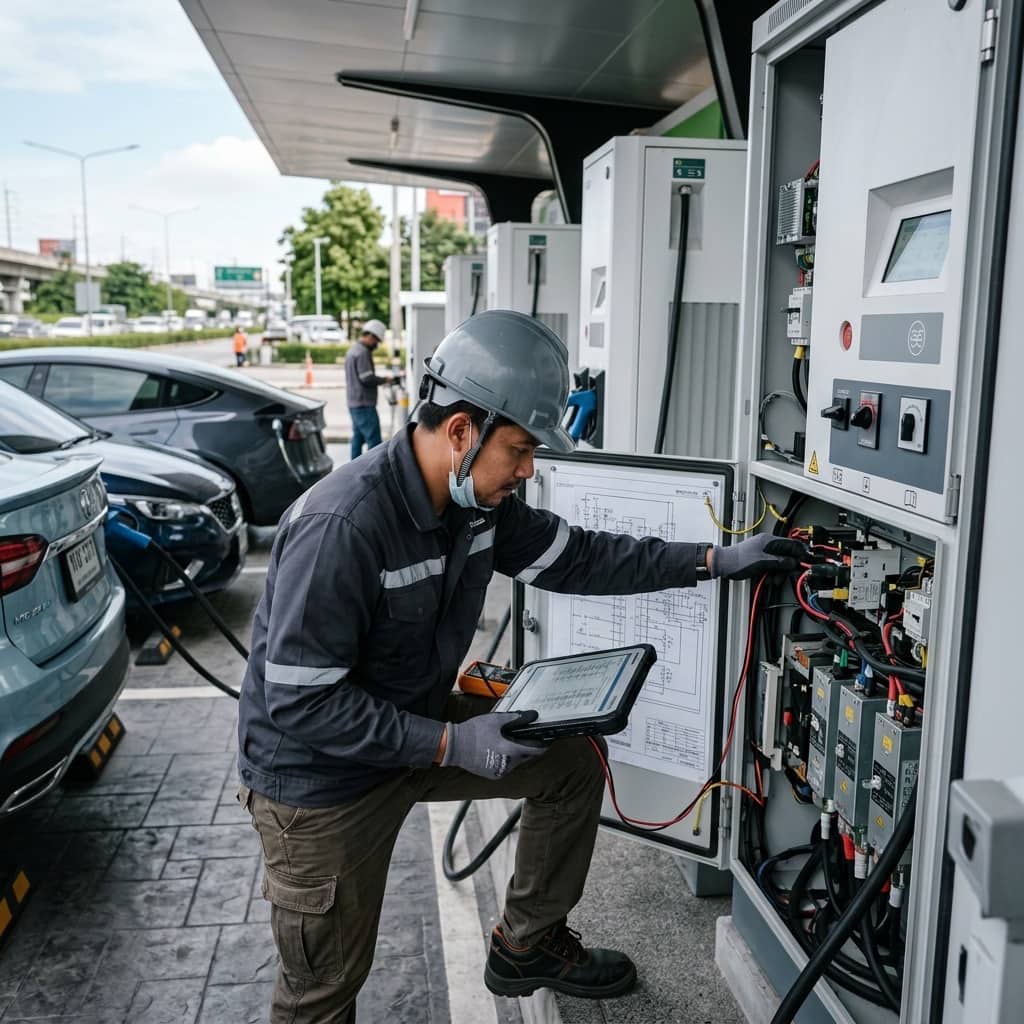
An often overlooked layer is monitoring within the electrical system itself: arc fault detection devices (AFDD) on charging circuits, temperature sensors on busbars and critical terminations in distribution boards, and trending of cumulative leakage current from the management system to catch insulation degradation before it becomes critical. All of it should integrate with the building's fire alarm system, with logic that automatically disconnects the affected charging zone on a high-level alarm and notifies staff — never left as a silent indication on an unwatched screen.
- Fixed thermal cameras continuously scan vehicles and chargers
- Aspirating smoke detection catches the earliest off-gassing
- AFDDs and temperature sensors at critical board terminations
- Integrate all layers into the building fire alarm system
4. Emergency Preparedness and Common Shortcomings
Common shortcomings in buildings that installed everything but cannot use it include emergency shutoff buttons without clear signage or blocked by stored items, building staff unaware of shutoff locations and which circuits they isolate, response plans never drilled with the local fire brigade, and extinguishers of types unsuited to battery fires installed under the assumption they are interchangeable. Thermal cameras with poorly tuned alarm thresholds generate so many false alerts that staff stop paying attention — worse than having no system.
Correct practice is an EV-specific response plan covering power isolation steps, evacuation, notification to the fire brigade with explicit mention of a lithium battery incident, and a designated quarantine position for the damaged vehicle to be observed after the event given reignition risk. Drill with building staff at least annually, review detection alarm thresholds quarterly against real operating data, and include functional testing of emergency shutoffs in every annual maintenance cycle.
Need engineering consultation regarding EV Infrastructure?
The WIN TECH SERVICE engineering team is ready to provide site surveys, electrical system inspections, and prepare accurate legal certification reports.