Transformer Online Monitoring Systems (TOMS): Sensor Integration & AI Diagnostics
📌 Executive Summary
Integrating online DGA gas sensors, bushing Tan Delta monitors, fiber-optic winding temperature probes, and oil level telemetry.
1. From Time-Based Maintenance to Online Monitoring
Power transformers are among the highest-value assets in any electrical system, and a catastrophic transformer failure typically means months of outage due to long replacement lead times. Traditional maintenance based on annual oil sampling can miss fast-developing defects such as partial discharge or hot spots that escalate within weeks. A Transformer Online Monitoring System (TOMS) fills this gap with sensors measuring continuously around the clock, shifting practice from time-based to condition-based maintenance driven by the actual state of the asset.
Key parameters monitored by TOMS include dissolved gases — especially hydrogen, the earliest indicator of nearly every fault type — moisture in oil, top-oil and winding hot-spot temperatures, load current, On-Load Tap Changer (OLTC) behaviour, bushing capacitance and tan delta, and partial discharge activity. Analyzed together, these reveal the fault type, its approximate location, and its rate of development — information that annual offline testing simply cannot provide.
- Dissolved gas: hydrogen as the earliest fault indicator
- Top-oil and winding hot-spot temperatures
- Moisture in oil and OLTC condition
- Bushing capacitance and tan delta
- Partial discharge activity
2. DGA Interpretation Standards and Condition Assessment
Dissolved Gas Analysis (DGA) interpretation follows two principal standards, IEC 60599 and IEEE C57.104, which classify fault types from gas signatures: acetylene (C2H2) indicating high-energy arcing, ethylene (C2H4) indicating overheating, and hydrogen with methane indicating partial discharge. Common interpretation tools include the Duval Triangle and Rogers Ratios. More significant than absolute values is the rate of change of gas concentrations — where online systems hold a clear advantage, showing hourly trends instead of yearly snapshots.
For thermal assessment, IEC 60076-7 (loading guide) and IEEE C57.91 provide models for calculating winding hot-spot temperature from load and ambient conditions. TOMS uses these to estimate loss of insulation life in real time and to compute dynamic loading capability — telling operators how far and how long a transformer can be loaded beyond nameplate without accelerating insulation aging past acceptable limits. This is especially valuable during emergencies when load must be transferred between transformers.
- IEC 60599 / IEEE C57.104: DGA interpretation
- Duval Triangle and Rogers Ratios for fault classification
- IEC 60076-7 / IEEE C57.91: thermal models and loading guides
- Gas rate of change matters more than absolute values
3. Sensor Installation Design and System Integration
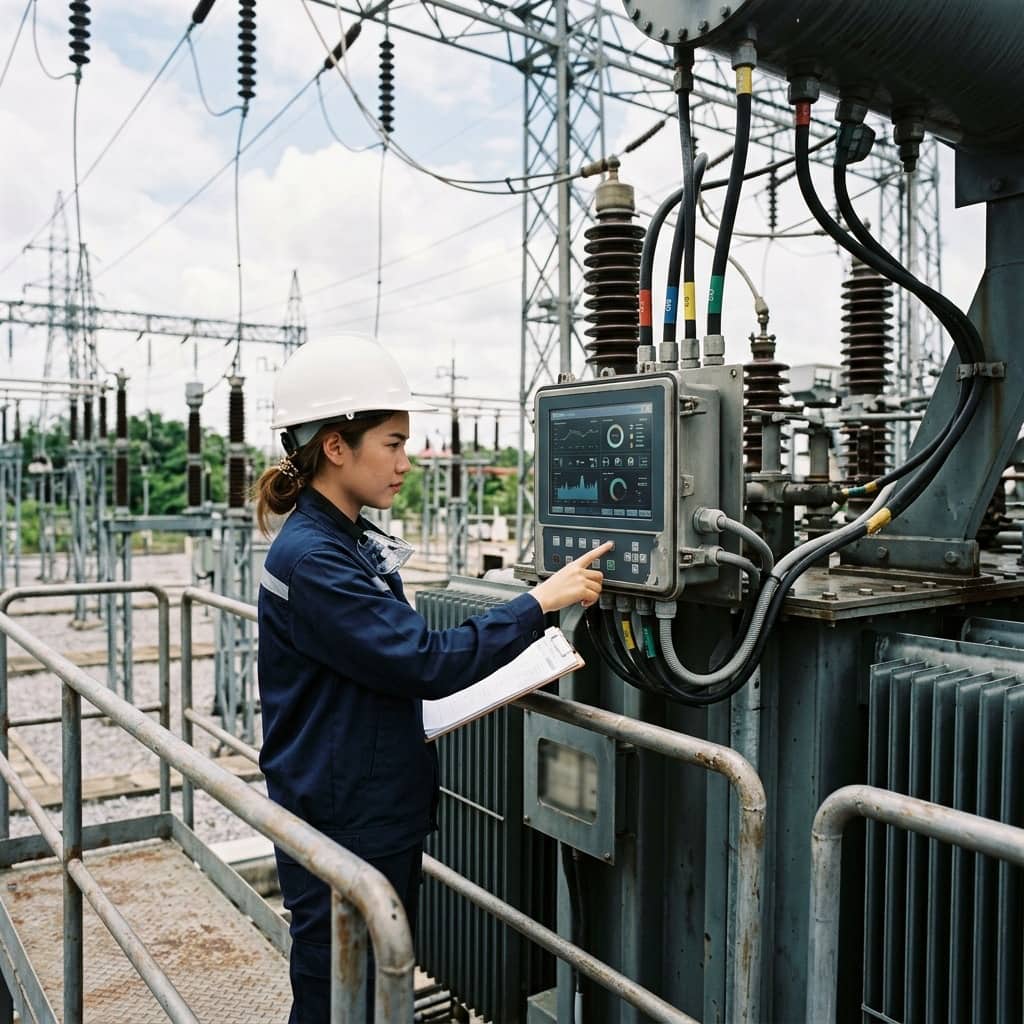
Installing TOMS on an in-service transformer requires careful planning. Online gas sensors mount on oil valves selected for good oil circulation; hot-spot temperature may be derived from thermal models using top-oil and load data, or measured directly by fiber-optic probes embedded in windings on new units. Bushing monitoring uses adapters at the bushing test tap — an area demanding particular care, since an open, unterminated test tap can destroy the bushing. Partial discharge measurement commonly uses UHF sensors or HFCTs on ground leads. Most installation work should be aligned with planned outages for safety.
For data integration, modern TOMS feeds SCADA or asset management platforms via standard protocols such as IEC 61850, Modbus, or DNP3. The design must define a clear alarm hierarchy — watch, alarm, and immediate-action levels — with named responsibility for each. The trap to avoid is over-sensitive thresholds producing frequent nuisance alerts, which desensitize operators until real signals are ignored. Alarm thresholds should be tuned against each transformer's own baseline after an initial data-collection period.
4. AI-Assisted Diagnostics and Their Limitations
The strength of predictive analytics and machine learning on TOMS data lies in multivariate anomaly detection — flagging, for example, temperatures abnormal relative to the simultaneous load and ambient conditions, patterns invisible on single-variable charts. Models can learn each transformer's normal behaviour from history and alert on early deviations, and they support fleet ranking to prioritize maintenance budgets rationally across an asset population.
The limitations must be understood honestly. AI output is only as good as sensor data quality: a drifting or uncalibrated sensor produces false alerts or masks real signals. Major decisions such as removing a transformer from service still require expert engineering confirmation through offline testing — for instance laboratory oil samples to verify online DGA readings. Good practice treats AI as a screening and prioritization tool, not a substitute for human judgement, backed by scheduled sensor calibration and periodic cross-checks of online data against laboratory results.
Need engineering consultation regarding Substation & Automation?
The WIN TECH SERVICE engineering team is ready to provide site surveys, electrical system inspections, and prepare accurate legal certification reports.