Voltage Flicker & Rapid Voltage Changes (RVC) from Welding & Arc Furnaces
📌 Executive Summary
Measuring Pst and Plt flicker severity indices according to IEC 61000-4-15 and deploying STATCOM reactive power compensation.
1. Flicker and Voltage Fluctuation: From Welders to Furnaces
Voltage flicker is caused by loads whose current changes rapidly and repetitively, making system voltage oscillate rhythmically. Even fluctuations of a few percent become highly visible when their frequency falls in the roughly 1-25 Hz band where the human eye is most sensitive to lamp brightness changes, causing annoyance and eye fatigue for workers. The classic source is the electric arc furnace, whose arc current swings violently during scrap melting, followed by resistance spot welders, arc welders, and frequently starting motors.
Beyond visual annoyance, rapid voltage changes (RVC) affect other equipment on the same system, causing motor torque pulsation and misoperation of electronics. Where a plant shares a feeder with other customers, the problem can escalate into utility complaints, and the source can be traced from the voltage fluctuation signature. Operators should therefore address flicker at its origin before connection conditions force them to.
2. Pst / Plt Indices and Assessment Standards
Flicker is measured with a flickermeter per IEC 61000-4-15, which models lamp response and human visual perception to produce the short-term severity index Pst (computed every 10 minutes) and long-term index Plt (averaged from twelve Pst values over 2 hours). A Pst of 1.0 is the level at which most observers begin to find flicker irritating. EN 50160 uses Plt as a criterion for distribution voltage quality.
For equipment emissions, the IEC 61000-3 series sets limits for devices connected to low-voltage systems, while large industrial loads on medium and high voltage are commonly assessed by allocating flicker quotas based on the short-circuit capacity at the connection point. The overall principle is that a stronger upstream system (higher short-circuit power) suffers less from fluctuating loads, so any assessment before installing a furnace or large welder must incorporate short-circuit data from the utility.
- IEC 61000-4-15 — flickermeter and the Pst / Plt indices
- Pst = 1.0 is where most observers start to be annoyed
- EN 50160 — uses Plt to assess distribution voltage quality
- Short-circuit capacity at the connection point is essential input
3. Locating Sources and Analyzing Severity
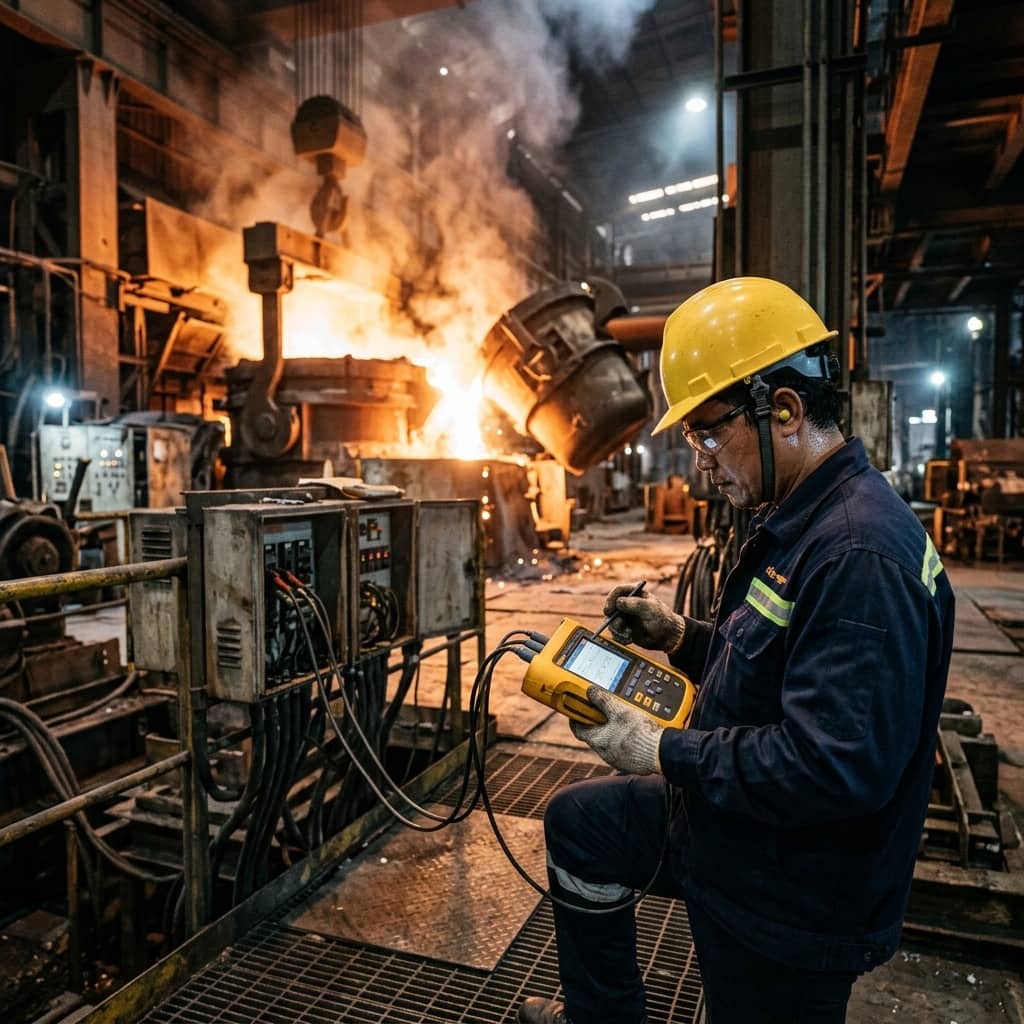
Analysis begins with IEC 61000-4-15 capable analyzers installed simultaneously at the PCC and at the suspected load feeder, recording continuously for at least a week across all production shifts. Periods of elevated Pst are then correlated with the operating schedule of furnaces, welders, or other machinery; a time match identifies the source with confidence. The current change magnitude (ΔI) is measured and the resulting voltage change (ΔV) computed through the system impedance.
For new fluctuating-load projects, predictive analysis should precede installation, combining the machine builder's load characteristics with the short-circuit capacity at the connection point to estimate the resulting Pst. If the prediction exceeds limits, compensation can be planned from the outset, which is far cheaper than remediation after the machine is in service and avoids conflicts with neighboring customers from day one.
4. Flicker Mitigation Technologies and Practical Measures
The principal compensation devices for severely fluctuating loads are the Static Var Compensator (SVC) and the STATCOM, which supply rapidly varying reactive power in step with the load. Modern power-electronic STATCOMs respond faster and suppress flicker better in the frequency band the eye perceives. For arc furnaces, a series reactor additionally stabilizes the arc and reduces current swings.
Measures that avoid major equipment investment also help: segregating fluctuating loads onto dedicated transformers or feeders away from lighting and office loads, connecting at a higher voltage level with greater short-circuit capacity, staggering the schedules of multiple welders so their cycles do not coincide, and switching to lighting types less sensitive to flicker. Engineers should rank measures from lowest to highest cost, letting measurement results decide how far to go.
- STATCOM / SVC for fast reactive power compensation
- Series reactors stabilize the arc in furnaces
- Segregate fluctuating loads from lighting and office circuits
- Stagger multiple welders so duty cycles do not coincide
Need engineering consultation regarding Power Quality & Energy?
The WIN TECH SERVICE engineering team is ready to provide site surveys, electrical system inspections, and prepare accurate legal certification reports.